Introduction: A Generation Unlike Any Before Them
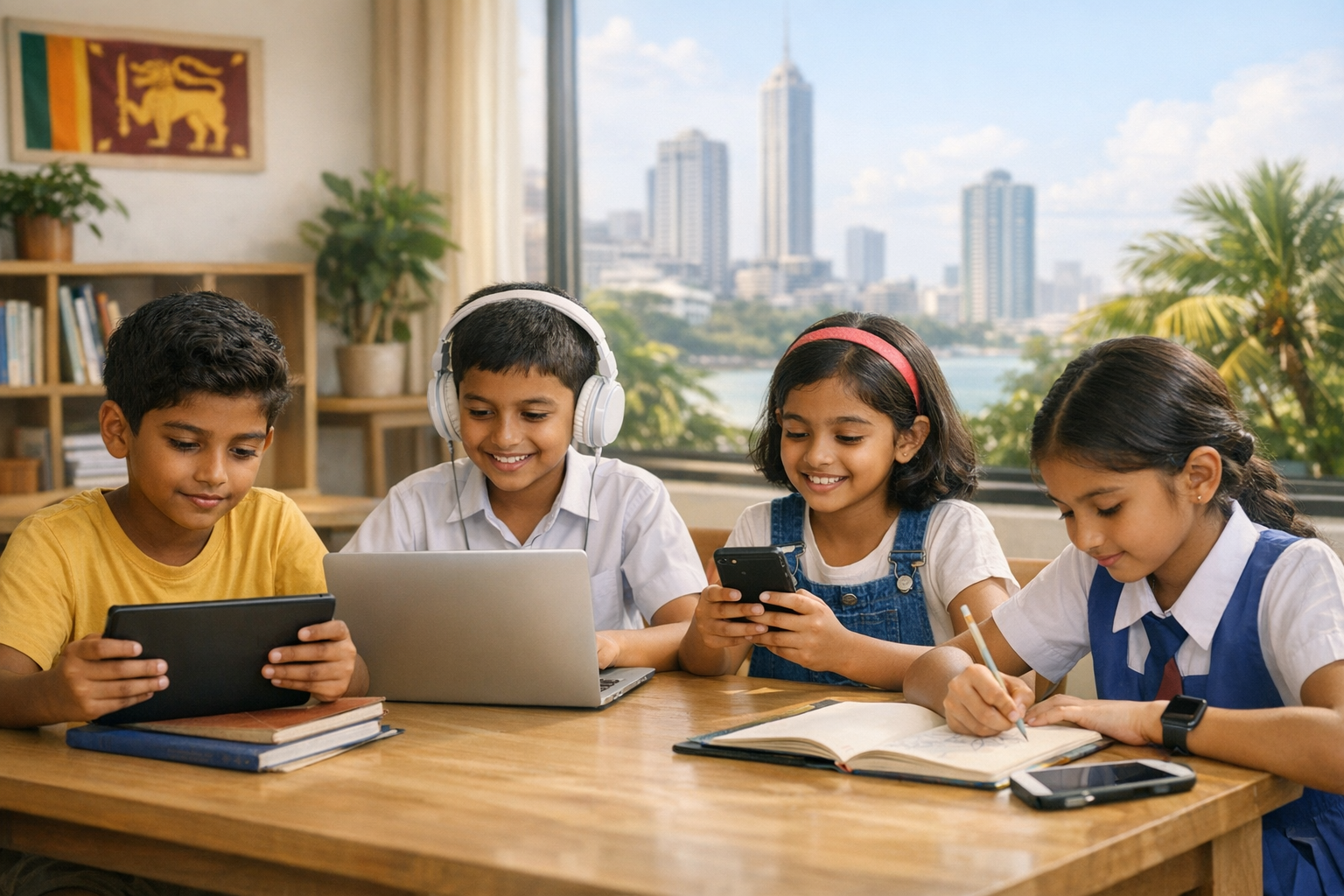
Walk into any Sri Lankan household with young children today. You will likely find a toddler navigating a tablet with more confidence than their grandparent handles a television remote. You may see a six-year-old explaining to their parent how to use a feature on their phone. You will almost certainly encounter a child who has grown up hearing "Hey Siri" or "OK Google" as naturally as they hear "good morning."
These children are the Alpha Generation — and they are the most distinctly different generation of children in human history.
They were born into a world that was already digital, already globalised, and already accelerating at a pace no previous generation had experienced. They did not adapt to technology. Technology was simply the water they swam in from birth.
And yet, for all their digital fluency, many Alpha Generation children in Sri Lanka are growing up in households, schools, and communities that were designed for a completely different kind of child — with completely different needs, learning styles, and psychological profiles.
At Persona Mind, we believe that understanding the Alpha Generation is not optional for Sri Lankan parents, teachers, and mental health professionals. It is urgent. Because the gap between who these children are and how we are raising, educating, and supporting them has real and lasting consequences for their mental health, their development, and our society's future.
This is your comprehensive guide to the Alpha Generation — grounded in psychology, rooted in the Sri Lankan context, and written for every adult who loves, teaches, or cares for these remarkable, complex children.
Who Is the Alpha Generation?
The Alpha Generation refers to children born from approximately 2010 onwards — with the cohort generally considered to extend to those born around 2025. Named by Australian social researcher Mark McCrindle, "Generation Alpha" follows Generation Z and represents the first generation to be born entirely within the 21st century.
In Sri Lanka, the oldest Alpha Generation children are currently between 13 and 15 years old. The youngest are still toddlers. This means that as a society, we are in the critical window of shaping who this generation will become — a responsibility that requires us to first understand who they already are.
Here is what defines them:
Digitally Native from Birth — Unlike Millennials who adapted to digital life, or Gen Z who grew up as it expanded, Alpha Generation children were born after the smartphone was already ubiquitous. The iPad was launched in 2010 — the same year the oldest Alphas arrived. For these children, a world without touchscreens, streaming, and instant access to information is simply unimaginable.
The Most Formally Educated Generation in History — Globally and in Sri Lanka, Alpha Generation children are entering formal education earlier than any previous generation, with greater access to structured learning environments, online educational tools, and extracurricular development programmes.
Children of Millennials — Alpha Generation children are primarily the children of Millennial parents — the generation that grew up with the internet, values work-life balance, prioritises emotional intelligence, and approaches parenting with significantly more information and intentionality than previous generations.
Shaped by Global Events from the Start — The oldest Alpha Generation children in Sri Lanka experienced the COVID-19 pandemic during their most formative early childhood and primary school years. The lockdowns, school closures, and social disruptions of 2020 and 2021 left a measurable imprint on their social development, emotional regulation, and relationship with learning.
The Largest Generation in Human History — By the time the last Alpha Generation child is born, this cohort will number approximately two billion people worldwide — making it the largest generation ever recorded.
How Alpha Generation Children Think and Behave: The Psychological Profile
Understanding Alpha Generation children requires us to look beyond their relationship with technology and examine the deeper psychological characteristics that define how they experience the world.
They Are Visual and Experiential Learners
Alpha Generation children have grown up in an environment saturated with rich, dynamic visual content — YouTube videos, animated apps, interactive games, and short-form content designed to be immediately engaging. As a result, they are strongly oriented toward visual and experiential learning rather than text-based, rote, or passive instruction.
They learn best when they can see, interact with, and directly experience concepts. Abstract instruction without visual or experiential grounding holds their attention poorly — not because they lack intelligence, but because their cognitive processing has been shaped by an entirely different information environment than the one their parents or teachers grew up in.
This has profound implications for Sri Lankan classrooms, which remain heavily reliant on chalk-and-talk instruction, rote memorisation, and text-heavy examination systems.
They Expect Immediacy
In the world Alpha Generation children inhabit, answers are instantaneous, entertainment is on-demand, and feedback is immediate. This creates a psychological orientation toward immediacy — a low tolerance for delay, a preference for fast feedback loops, and a reduced capacity for sustained engagement with slow-building processes.
This is frequently misread by adults as impatience or lack of discipline. Psychologically, it is more accurate to understand it as a calibration to a different information environment — one that rewards quick processing and rapid response rather than sustained, linear attention.
They Have a Sophisticated Sense of Self and Identity
Partly influenced by their Millennial parents — who tend to raise children with greater emphasis on individual identity, emotional expression, and personal values — and partly shaped by their exposure to global content that celebrates diversity and individuality, Alpha Generation children often develop a remarkably sophisticated and assertive sense of self from a young age.
They are comfortable questioning authority, expressing their opinions, and resisting instructions they find arbitrary or unjust. This can be challenging for Sri Lankan parents and teachers accustomed to more hierarchical, compliance-based models of child-adult relationships — but it is also a significant psychological strength that, when guided well, produces highly self-aware and values-driven young people.
They Are Socially Fluent but Emotionally Developing
A paradox at the heart of the Alpha Generation is that while they are often highly socially articulate — comfortable with diverse peers, culturally aware, and skilled at navigating online social environments — many also show signs of underdeveloped emotional regulation skills.
The reason is neurological as much as environmental. Deep emotional regulation — the ability to manage frustration, tolerate discomfort, delay gratification, and navigate complex interpersonal conflict — develops primarily through real-world social experience: playground disagreements, face-to-face conflict resolution, and the gradual, sometimes painful process of learning to manage feelings in embodied, physical social situations.
When significant portions of social interaction occur through screens — where one can simply close an app to end an uncomfortable conversation, or avoid conflict entirely — these crucial developmental experiences are reduced. The result is children who are socially confident in many contexts but who may struggle with the messiness and discomfort of deep emotional experience.
Alpha Generation and Mental Health: What Sri Lanka Needs to Understand
This is perhaps the most important section of this article — and the one closest to Persona Mind's mission.
The mental health landscape for Alpha Generation children is being shaped by forces that are genuinely unprecedented. No previous generation of psychologists, parents, or educators has navigated exactly this terrain. And while research is still emerging, the early signals are serious enough to warrant urgent attention.
The Screen Time Question: More Complex Than We Think
Screen time is the issue most Sri Lankan parents ask about when it comes to their Alpha Generation children. And it is a legitimate concern — but it is also more nuanced than the simple "less screen time = better outcomes" formula that is often presented.
Research, including the influential work of developmental psychologist Jean Twenge on iGen (Generation Z) and emerging studies on Alpha Generation children, suggests that the relationship between screen time and mental health is not simply about quantity — it is critically about quality, context, and what screen time displaces.
Passive consumption — scrolling through short-form content, watching videos without interaction — shows the strongest associations with negative mental health outcomes, including increased anxiety, reduced attention span, and poorer sleep quality.
Interactive and educational screen use — video calling with family, educational apps with genuine learning content, creative digital tools — shows a far more neutral or even positive relationship with developmental outcomes.
What screen time displaces matters enormously. Screen time that replaces physical play, outdoor activity, face-to-face socialisation, and adequate sleep is associated with poorer outcomes. Screen time that occurs in addition to these activities, in a regulated and intentional way, is considerably less concerning.
In Sri Lanka, where many families use screens as primary entertainment, as childcare supplements, and as educational tools simultaneously — often without clear boundaries between these functions — the challenge is to move toward intentional, structured screen engagement rather than simply reducing hours.
Anxiety and the Alpha Generation
Anxiety is emerging as one of the most significant mental health concerns for Alpha Generation children globally — and there are specific factors in the Sri Lankan context that amplify this risk.
Information overload — Alpha Generation children are exposed to an extraordinary volume of information, including news, global crises, and social content, from a very young age. Their developing nervous systems are not equipped to process and contextualise this volume of input. The result, for many children, is a chronic low-level state of overwhelm that can manifest as anxiety, sleep disturbance, and emotional dysregulation.
Comparison culture — Social media platforms, even those ostensibly designed for children, expose Alpha Generation children to constant social comparison — with peers, with influencer content, and with idealised representations of childhood, appearance, and achievement.
Leon Festinger's Social Comparison Theory tells us that humans instinctively evaluate themselves relative to others; for children whose sense of self is still forming, this constant comparative pressure can be psychologically devastating.
Academic pressure in Sri Lanka's competitive education system — The Sri Lankan education system, with its high-stakes examinations and intense emphasis on academic performance from a young age, creates significant pressure for Alpha Generation children who are also navigating the demands and distractions of a fully digital world. The collision between a system designed for linear, focused, text-based learning and children whose cognitive profiles are oriented toward visual, interactive, multimodal learning is producing significant stress in many young Sri Lankans.
Post-pandemic residue — Sri Lankan Alpha Generation children who were between approximately 5 and 10 years old during the COVID-19 pandemic experienced prolonged disruption to their social development, educational continuity, and sense of safety during critical developmental windows. Research is increasingly clear that the mental health consequences of pandemic-era childhood disruptions are long-lasting and require active, intentional support to address.
Emotional Dysregulation: The Hidden Challenge
One of the most consistent concerns raised by Sri Lankan parents and teachers at Persona Mind is what they describe as emotional volatility in Alpha Generation children — intense reactions to frustration, difficulty tolerating disappointment, and challenges with self-soothing when upset.
Psychologist
Ross Greene's work on collaborative problem-solving helps us understand this through the lens of lagging skills rather than behavioural defiance. Many Alpha Generation children are not choosing to be difficult — they genuinely lack the neurological and experiential scaffolding to regulate intense emotions, because the environments they have grown up in have not consistently provided the conditions in which these skills develop.
Lev Vygotsky's concept of the Zone of Proximal Development is instructive here. Children develop emotional regulation skills most effectively when they are supported through emotionally challenging experiences by a calm, attuned adult — not when they are simply removed from discomfort (as closing an app allows), and not when they are left to manage overwhelming emotions entirely alone.
For Sri Lankan parents navigating this, the implication is clear: children need to experience manageable difficulty, with adult support, to develop the emotional muscles that difficult life will require of them.
Attention, Focus, and the Developing Brain
Concerns about attention and focus are widespread among Sri Lankan parents and teachers of Alpha Generation children. And while it would be an oversimplification to attribute all attention difficulties to screen use, there is genuine neurological basis for concern.
Neuroscientist Michael Merzenich's research on neuroplasticity — the brain's ability to reorganise itself based on experience — shows that repeated engagement with fast-paced, highly stimulating digital content literally shapes the neural pathways involved in attention. Brains that are repeatedly rewarded for rapid attention-switching become more efficient at rapid attention-switching — and less practiced at the sustained, focused, single-task attention that traditional education and deep learning require.
This does not mean Alpha Generation children cannot develop sustained attention. It means that developing it requires deliberate, consistent practice — through reading, through structured play, through activities that reward patience and persistence — in an environment that does not always compete with a more immediately stimulating alternative.
Alpha Generation in Sri Lankan Classrooms: A System at a Crossroads
Sri Lanka's education system is one of the most admired in South Asia for its reach and historical commitment to universal literacy. But it was designed for a different kind of learner — and many of its core assumptions about how children learn, what motivates them, and how they engage with knowledge are increasingly misaligned with the Alpha Generation children now filling its classrooms.
The Learning Style Mismatch
Howard Gardner's Theory of Multiple Intelligences has long challenged the assumption that intelligence is singular and measurable by academic examination alone. Alpha Generation children, as a cohort, tend to exhibit strong spatial, interpersonal, and kinesthetic intelligences alongside the linguistic and logical-mathematical intelligences that Sri Lanka's exam-centric system primarily rewards.
The child who struggles to sit still and memorise historical dates but who can build a complex structure in Minecraft, explain a YouTube video's content with remarkable analytical clarity, or mediate a conflict among friends with genuine emotional sophistication — this child is not failing to learn. They are learning in ways that the current system does not see or reward.
The Authority Question in Sri Lankan Schools
Sri Lanka's educational culture is traditionally built on a model of hierarchical authority — the teacher as the source of knowledge, the student as the receptive vessel. Alpha Generation children, who are accustomed to questioning, exploring, and constructing their own understanding through interactive digital environments, frequently find this model frustrating and disengaging.
This is not disrespect — though it is often experienced that way by teachers who were themselves trained within the traditional model. It is a fundamentally different orientation to knowledge and learning that requires educators to develop new skills: facilitating inquiry rather than delivering instruction, engaging curiosity rather than demanding compliance, and building relationships of mutual respect rather than enforcing hierarchical deference.
What Effective Education for Alpha Generation Children Looks Like
Progressive educators and child psychologists increasingly agree that Alpha Generation children learn most effectively in environments that offer:
Project-based and inquiry-driven learning — where children investigate real questions, solve real problems, and construct understanding through doing rather than passively receiving.
Integration of technology as a tool — not as a distraction to be eliminated, but as a genuine instrument of learning, used intentionally and critically.
Regular physical activity and movement — neuroscience consistently shows that physical movement enhances cognitive function, emotional regulation, and learning retention.
Emotional safety and psychological security — Abraham Maslow's Hierarchy of Needs reminds us that children cannot learn effectively when they feel unsafe, unvalued, or emotionally dysregulated. A classroom culture of psychological safety is not a luxury — it is a prerequisite for genuine learning.
Immediate, specific, and meaningful feedback — consistent with Alpha Generation children's orientation toward immediacy and their need to understand the relevance of what they are learning.
Parenting the Alpha Generation in Sri Lanka: Challenges and Guidance
Sri Lankan parents of Alpha Generation children are navigating genuinely unprecedented terrain. Many are Millennial parents who bring greater psychological awareness and intentionality to parenting than previous generations — but who are also busier, more stressed, and more digitally distracted themselves than any previous generation of parents.
The challenges are real. Here is how psychology can help.
Challenge 1: The Battle Over Screens
Almost every Sri Lankan parent of an Alpha Generation child describes the same battle — the daily negotiation, confrontation, or capitulation around screen time. And the psychological dynamics of this battle are often counterproductive.
When screen time becomes a site of conflict and control, several things happen. First, screens take on an inflated psychological value — the forbidden fruit effect, well documented in reactance theory (Brehm), means that restricting something increases desire for it. Second, children learn to associate screen use with defiance and adult disapproval rather than with intentional, enjoyable activity. Third, the relationship between parent and child becomes adversarial rather than collaborative — which undermines the trust and connection that is the foundation of effective parenting influence.
A more psychologically effective approach involves co-regulation and collaborative boundary-setting — working with children to establish screen time agreements they genuinely understand and have participated in creating, rather than imposing limits that feel arbitrary and invite circumvention.
Challenge 2: Raising Emotionally Resilient Children in a Digital World
Daniel Siegel's concept of "connect then redirect" is one of the most practically useful frameworks for Sri Lankan parents of Alpha Generation children. When a child is emotionally dysregulated — having a meltdown over a game that went wrong, dissolving into tears when screen time ends, erupting in anger at a perceived unfairness — the instinctive adult response is often to immediately correct, instruct, or punish the behaviour.
Neurologically, this is ineffective. A dysregulated brain cannot process instruction or respond to reason. Connection — a calm presence, physical comfort if welcomed, emotional validation — must come first. Once the child's nervous system has settled, the teaching moment becomes possible.
This requires parents to be emotionally regulated themselves — which is its own challenge in the context of Sri Lankan family life, with its pressures of extended family expectations, economic stress, and the demands of modern working life.
Challenge 3: Navigating Sri Lanka's Intergenerational Gap
One of the unique challenges of raising Alpha Generation children in Sri Lanka is the intergenerational complexity of many Sri Lankan families. In households where grandparents are significantly involved in child-rearing — as is common in Sri Lankan culture — the gap between the Alpha Generation child's world and the grandparent generation's assumptions about childhood, discipline, and development can be enormous.
Grandparents who raised children through corporal punishment, strict hierarchy, and absolute compliance may struggle profoundly with Alpha Generation grandchildren who question, negotiate, and express their feelings openly. This generational collision, when it occurs within the family unit, creates stress for parents caught between generations, confusion for children receiving contradictory messages, and conflict that can fracture family relationships.
Open, respectful family conversations about parenting philosophy — ideally with professional guidance when needed — are increasingly important for Sri Lankan multigenerational households navigating this complexity.
Challenge 4: Protecting Mental Health Without Overprotecting
One of the most delicate balancing acts for Sri Lankan parents of Alpha Generation children is the tension between protection and resilience-building.
Parenting research consistently shows that children develop resilience not by being shielded from all difficulty, but by experiencing manageable challenges with adult support. Angela Duckworth's research on grit — the combination of passion and perseverance that predicts long-term achievement and wellbeing — shows that children develop this quality through sustained effort in the face of difficulty, not through environments of constant comfort and immediate success.
In Sri Lanka, where parental love is often expressed through provision, protection, and sacrifice — and where the desire to give children what one did not have oneself is a powerful parental motivator — the impulse to shield Alpha Generation children from struggle is understandable and loving. But it can inadvertently produce children who are poorly equipped for the real difficulties that adult life will bring.
The goal is not to eliminate difficulty. It is to ensure children face difficulty with the right support. This is the heart of what Persona Mind means when we talk about building emotionally resilient Sri Lankan children.
What Alpha Generation Children Need Most: A Psychological Summary
Across all the research, all the theory, and all the clinical observation, the core needs of Alpha Generation children remain profoundly, reassuringly human:
They need secure attachment. John Bowlby's Attachment Theory remains as relevant for Alpha Generation children as for any generation before them. Children who have a reliable, warm, responsive attachment figure — a parent, grandparent, or caregiver who is consistently present and emotionally attuned — develop the psychological security from which all healthy development flows. No technology, educational programme, or intervention replaces this.
They need to be seen as whole people. Alpha Generation children are more than their screen use, their academic performance, or their behaviour at their worst moments. They are curious, creative, deeply feeling human beings navigating a world of extraordinary complexity. They need adults who see and celebrate their full humanity.
They need boundaries set with love. Structure, consistency, and clear boundaries are not the enemy of Alpha Generation children's wellbeing — they are essential to it. But the most effective boundaries are those set within a relationship of warmth and respect, explained with genuine reasoning, and enforced with consistency rather than harshness.
They need adults who stay curious. The adults who will have the greatest positive influence on Alpha Generation children are those who remain genuinely curious — about who these children are, how they experience the world, and what they need — rather than those who approach them with fixed assumptions inherited from a different era.
They need to talk to someone. In Sri Lanka, as mental health awareness grows, we are seeing more parents recognise when their child needs professional support — and more children being given permission to seek it. This is a profoundly positive development. If your Alpha Generation child is struggling — with anxiety, emotional regulation, school pressure, or any of the challenges described in this article — professional support is available, effective, and nothing to be ashamed of.
A Message to Sri Lankan Parents, Teachers, and Caregivers
The Alpha Generation did not choose the world they were born into. They did not choose the speed, the noise, the screens, or the complexity. They arrived into it — and they are doing their best to make sense of it, just as every generation of children has done.
What they need from us is not perfection. They need presence. They need patience. They need adults who are willing to learn alongside them, to admit what we do not know, and to extend the same compassion to ourselves as parents and educators that we try to extend to them.
Sri Lanka has always placed enormous value on children — on their education, their futures, and their flourishing. The Alpha Generation deserves that same commitment, updated for the world they actually inhabit.
At Persona Mind, we walk alongside Sri Lankan families navigating the beautiful, difficult, unprecedented work of raising the Alpha Generation. We offer psychological support, parent guidance, and child therapy services that are grounded in evidence, rooted in our cultural context, and delivered with genuine care.
Because these children are worth understanding. And so are you.
Seek Support With Persona Mind
Whether you are a parent concerned about your child's emotional development, a teacher seeking guidance on supporting Alpha Generation learners, or a young person navigating your own mental health journey — Persona Mind is here.
© 2025 Persona Mind. All rights reserved. This article is intended for informational and educational purposes and does not constitute professional psychological advice. For concerns about your child's mental health or development, please consult a qualified mental health professional.