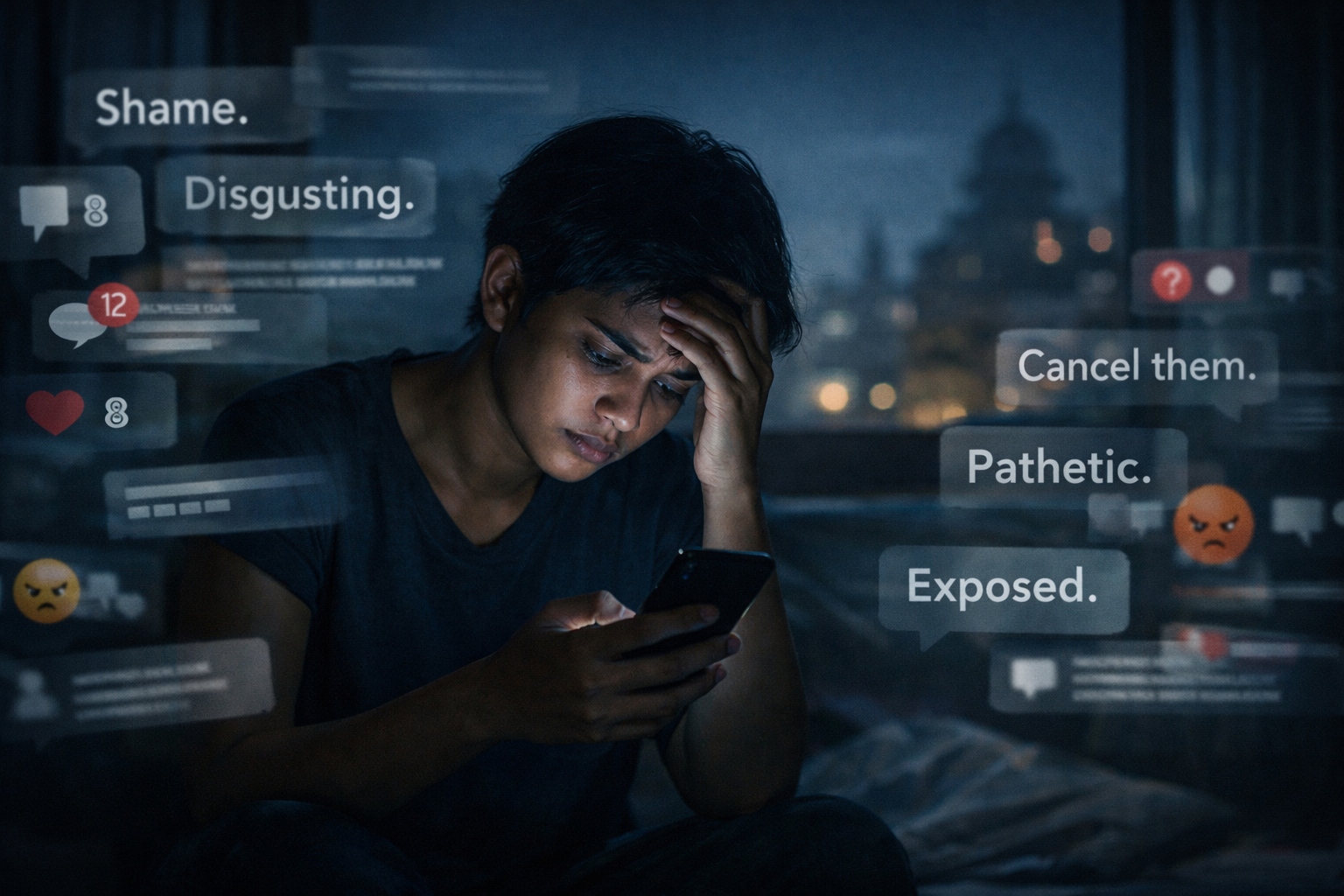
Introduction: The Screen That Judges You
Scroll. Like. Comment. Share. Shame.
If you have spent any time on TikTok or Facebook recently, you have likely witnessed it — a video goes viral not because it celebrates someone, but because it tears them apart. A comment section erupts into a coordinated attack. A person's worst moment, captured in seconds, becomes a nation's entertainment for days.
This is what psychologists and digital wellness experts now call digital toxicity — and at its most damaging core lies a phenomenon that is reshaping how Sri Lankans, and people worldwide, relate to each other online: the shaming culture.
At Persona Mind, we believe that understanding the psychological forces at play in these digital spaces is the first step toward protecting your mental health. In this article, we break down what digital toxicity and online shaming really are, the powerful psychological theories behind them, and what you can do to reclaim your mental wellbeing.
What Is Digital Toxicity?
Digital toxicity refers to the accumulation of harmful, hostile, or psychologically damaging content and behaviours that saturate our online environments. It includes hate speech, cyberbullying, misinformation, cancel culture, public humiliation, and the relentless negativity that floods platforms like TikTok and Facebook.
Unlike traditional toxicity — which was mostly confined to face-to-face interactions — digital toxicity operates at scale. A single cruel comment can be seen by thousands. A shaming video can reach millions within hours. The damage is amplified, accelerated, and, crucially, permanent.
The Shaming Culture: A New Kind of Public Punishment
Online shaming is not new — but its current form is uniquely destructive. On platforms optimised for engagement, outrage travels faster than empathy. When someone is shamed publicly on TikTok or Facebook, the pile-on effect takes hold almost instantly.
Consider these increasingly common scenarios in our local digital landscape:
- A video of someone behaving badly in public is posted, and within hours, their personal information, workplace, and family are exposed.
- A person shares a vulnerable moment online only to be mocked relentlessly in the comment section.
- A public figure — or even an ordinary citizen — becomes the subject of a coordinated harassment campaign.
What drives this? Why do people participate? And why does it feel so difficult to look away?
The Psychology Behind Online Shaming: Key Theories
Understanding the shaming culture requires us to look beneath the surface of the screen. Several well-established psychological theories help explain why online shaming happens — and why it causes such profound harm.
1. Social Identity Theory (Henri Tajfel & John Turner)
Tajfel and Turner's Social Identity Theory explains that humans define themselves through the groups they belong to — their "in-group." When we shame someone online, we are often signalling that the target belongs to an "out-group" that violates our values.
On TikTok and Facebook, this plays out constantly. Users rally around a shaming post not necessarily because they know the person or have all the facts, but because joining the pile-on reinforces their sense of belonging to a morally righteous group. The comment section becomes a tribe, and the shamed individual becomes the common enemy that unites them.
This is why shaming spreads so quickly — it is not just cruelty, it is social bonding through exclusion.
2. The Online Disinhibition Effect (John Suler)
Psychologist John Suler identified a phenomenon known as the Online Disinhibition Effect — the tendency for people to behave in ways online that they never would in person. Anonymity, physical distance from the target, and the absence of real-time emotional feedback all lower the psychological barriers that normally prevent cruelty.
On TikTok, where comments appear beneath content in rapid succession, users experience a kind of "crowd mentality" that further dissolves individual accountability. The result? People say things in comment sections that they would never dare utter face-to-face.
For the target, however, these are not just words on a screen. They are read, felt, and internalised — often repeatedly, in the quiet of night, alone.
3. Mob Mentality and Deindividuation (Leon Festinger)
Leon Festinger's research on deindividuation shows that when individuals feel anonymous as part of a larger group, their sense of personal responsibility diminishes significantly. They become less self-aware and more susceptible to the group's emotional momentum.
This is the psychological engine behind what we now call "pile-ons." Once a post gains traction and the comment section fills with outrage, each new commenter feels they are simply joining an already-justified movement. Individual moral reasoning is suspended. The mob takes over.
What begins as a community voicing concern can rapidly descend into coordinated harassment — and platforms like Facebook and TikTok, designed to maximise engagement, often algorithmically amplify this process.
4. The Bystander Effect in Digital Spaces (Darley & Latané)
The classic Bystander Effect — where individuals are less likely to intervene in an emergency when others are present — has a powerful digital equivalent. When thousands of people are watching a shaming thread unfold, most scroll past without intervening, assuming others will step in, or fearing becoming the next target themselves.
This silence is not neutrality. It is complicity by inaction — and it creates an environment where the shamed individual feels not just attacked, but abandoned.
5. Shame vs. Guilt: The Devastating Psychology of Public Humiliation (June Price Tangney)
Psychologist June Price Tangney's research distinguishes between guilt — feeling bad about something you did — and shame — feeling bad about who you are. While guilt can be constructive and motivate change, shame is deeply corrosive.
When someone is publicly shamed online, the attack is rarely limited to a specific behaviour. The comment sections quickly escalate into attacks on the person's appearance, intelligence, character, and worth as a human being. This triggers toxic shame — a pervasive sense of being fundamentally defective or unworthy.
Toxic shame is strongly associated with depression, anxiety, social withdrawal, and in severe cases, suicidal ideation. In Sri Lanka, where cultural expectations around reputation and family honour are deeply embedded, the impact of public online shaming can be especially devastating.
The Real-World Harm: What Digital Toxicity Does to Mental Health
The psychological damage of digital toxicity and online shaming is well-documented. At Persona Mind, we regularly see its effects in our counselling rooms. The impact includes:
For Targets of Online Shaming:
- Acute anxiety and hypervigilance (constantly checking for new comments or threats)
- Depression and social withdrawal
- Post-Traumatic Stress responses
- Damaged self-esteem and identity disruption
- In severe cases, suicidal thoughts and self-harm
For Bystanders Who Witness Toxicity:
- Compassion fatigue and emotional numbness
- Increased cynicism and distrust of others
- Normalisation of cruelty as entertainment
- Doomscrolling patterns and addictive platform engagement
For Active Participants in Shaming:
- Short-term dopamine reward reinforcing harmful behaviour
- Long-term erosion of empathy
- Cognitive distortions that justify cruelty as "justice"
The Algorithm Problem: Why Platforms Enable This
It would be incomplete to discuss digital toxicity without acknowledging the role of platform design. TikTok and Facebook operate on engagement-based algorithms — systems designed to show you more of what keeps you scrolling. Outrage, conflict, and emotionally charged content generate more reactions, more comments, and more shares than neutral or positive content.
This means platforms are, structurally, incentivised to amplify toxic content. From a psychological standpoint, this aligns with Operant Conditioning (B.F. Skinner) — the algorithm rewards outrage with visibility, training users and content creators alike to produce and engage with more of it.
The result is a feedback loop of toxicity that is not accidental — it is, in many ways, engineered.
What Can You Do? Practical Steps to Protect Your Mental Health
Understanding the psychology of digital toxicity empowers you to respond thoughtfully, rather than react impulsively. Here is what Persona Mind recommends:
1. Audit Your Digital Environment Regularly evaluate the content and communities you engage with. If your social media feeds consistently leave you feeling anxious, angry, or drained, that is a signal worth taking seriously.
2. Set Intentional Boundaries Time limits, notification controls, and designated "offline" periods are not signs of weakness — they are acts of self-respect. Use your phone's screen time settings to create boundaries that protect your mental space.
3. Practice the Pause Before commenting on a contentious post, pause. Ask yourself: "Would I say this to this person's face?" and "Am I contributing to a conversation, or to a pile-on?" This simple act re-engages the prefrontal cortex, the part of the brain responsible for rational decision-making.
4. Speak Up Safely If you witness online shaming and it is safe to do so, a calm and compassionate counter-comment can interrupt mob momentum and signal to the target that not everyone is against them.
5. Prioritise Offline Connections Social Identity Theory reminds us that humans need community. When our primary community exists online in toxic spaces, our sense of belonging becomes contingent on engagement in those spaces. Nurturing real-world relationships reduces this dependency.
6. Seek Professional Support If you or someone you know has been the target of online shaming or is struggling with the effects of digital toxicity, please reach out. The psychological wounds caused by online harassment are real, and you deserve support in processing them.
A Note for Sri Lankan Readers
In Sri Lanka, digital shaming often carries an added layer of cultural weight. Our society places significant value on community reputation, family honour, and social standing. When someone is publicly shamed online, the damage extends beyond the individual — it is felt by families, workplaces, and entire communities.
At Persona Mind, we understand this cultural context. Our therapists are equipped to help you navigate the unique intersection of digital harm and the social pressures specific to our society. You do not have to face this alone.
Conclusion: Reclaiming Humanity in the Digital Age
TikTok and Facebook are not inherently evil. They are tools — and like all tools, their impact depends on how they are used and how we choose to engage with them. But when platforms are designed to reward outrage, and when psychological forces like deindividuation and social identity pressures pull us toward mob behaviour, the potential for harm is enormous.
Digital toxicity and the shaming culture are mental health crises hiding in plain sight. They are shaping how a generation understands conflict, accountability, and human worth.
At Persona Mind, we are committed to making psychological insight accessible to Sri Lankans navigating these complex digital realities. Understanding the science is not enough — we must also commit to practising digital empathy, both for others and for ourselves.
Your mental health matters. Your worth is not determined by a comment section.
Need Support?
If you are experiencing the effects of online shaming, cyberbullying, or digital toxicity, Persona Mind is here to help. Our qualified therapists offer confidential, culturally sensitive counselling in Sri Lanka.
📍 Visit us: www.brandnova.site
Follow Persona Mind on Facebook and Instagram for weekly mental health insights.
© 2025 Persona Mind. All rights reserved. This article is for informational purposes only and does not replace professional psychological advice. If you are in crisis, please contact a qualified mental health professional immediately.