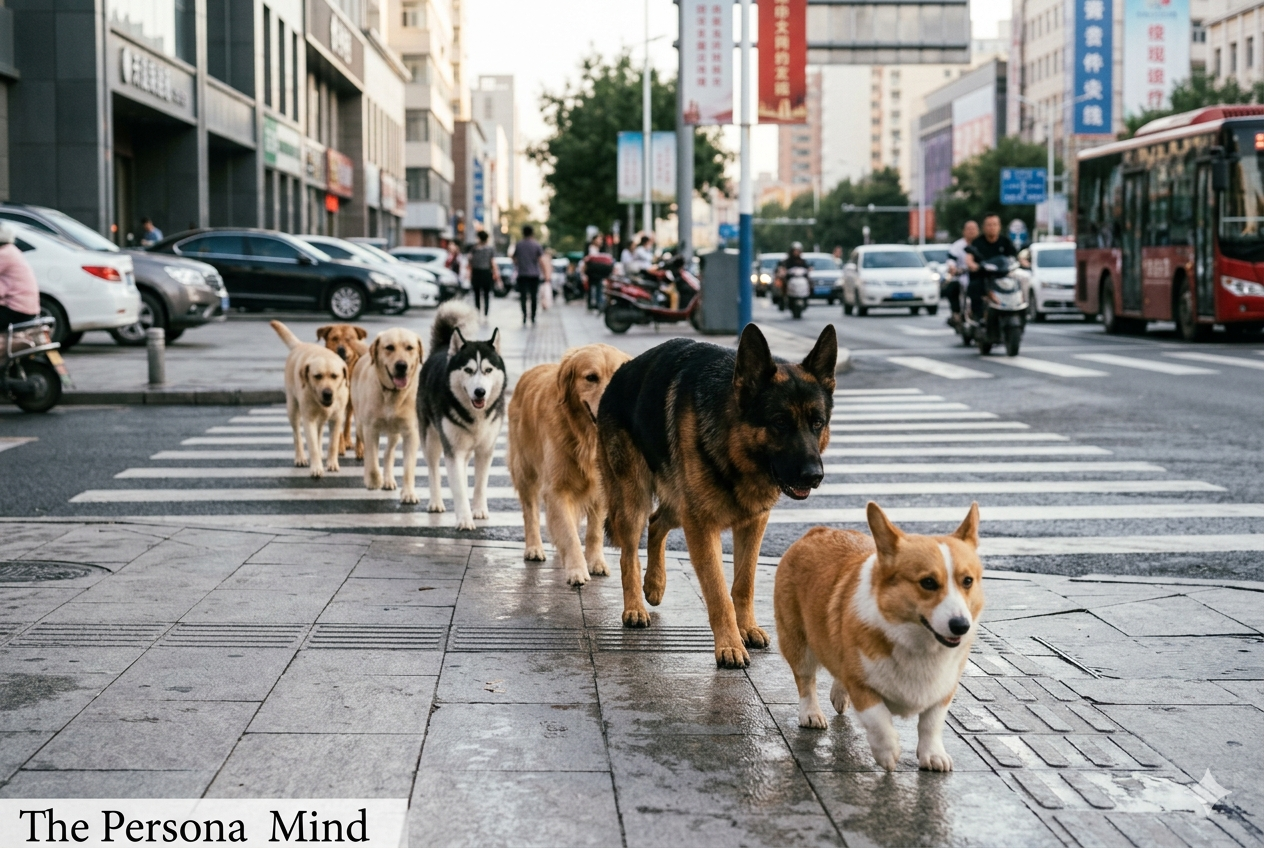
"They were not just walking. They were teaching."
Introduction: A Video That Stopped the World
In the age of endless scrolling, very few things truly make us pause.
But when footage emerged from Jilin Province, China, showing seven dogs moving in a calm, organised, single-file formation through busy city streets — the world stopped. People watched it over and over. They shared it with captions like "more organised than my entire team" and "this just made me cry and I don't know why."
Why did it move us so deeply?
Because somewhere beneath the laughter and the wonder, we recognised something. Something about belonging. About leadership. About not leaving anyone behind.
As a psychologist, I watched that footage and saw not just a remarkable animal behaviour — I saw a masterclass in the principles that govern every human team, every family, every community that has ever worked.
Today, through Persona Mind, I want to walk you through what those seven dogs were actually demonstrating — and what it means for the way we lead, follow, connect, and care for one another.
Part 1: Setting the Scene — What Actually Happened
The footage, which spread rapidly across social media, shows a group of seven dogs of varying breeds navigating the streets of Jilin Province with remarkable composure and coordination. They moved in a disciplined single-file line through traffic and pedestrian areas — not chaotically, not frantically, but with quiet, purposeful order.
What made it extraordinary was not simply that they were together. It was how they were together.
At the front: a Corgi — one of the smallest dogs in the group — confidently leading the way. Behind it: a German Shepherd, a Golden Retriever, a Labrador, and several mixed breeds, following in steady succession. One dog appeared to be slightly unwell or injured — and yet it was never left behind. The group slowed. It waited. It moved as one.
No human commanded this. No leash connected them. No external authority organised their formation.
They did it themselves.
And in doing so, they demonstrated psychological principles so sophisticated that we spend years teaching them in leadership seminars, therapy rooms, and organisational psychology courses.
Part 2: The Psychology of Emergent Leadership — The Corgi Who Shouldn't Have Been First
Let us begin with the most surprising element of this story: the leader.
In most popular imagination — and in many outdated theories of leadership — the leader of any group should be the biggest, the strongest, the most physically imposing. In a group that includes a German Shepherd, the idea that a Corgi would lead seems almost absurd.
And yet there it was. A small dog with short legs and an enormous confidence, setting the pace, reading the environment, making decisions — and being followed without question by dogs twice its size.
This is what psychologists call Emergent Leadership — and it is one of the most important concepts in modern leadership science.
What Is Emergent Leadership?
Emergent leadership describes a phenomenon where, in the absence of a formally appointed authority, a leader naturally rises from within the group — not because of their title, their size, or their seniority, but because of their behaviour, their competence, and the trust they inspire through consistent action.
Research in organisational psychology has consistently shown that emergent leaders share several key traits:
Situational awareness — they read the environment quickly and accurately, and adapt their decisions to what the situation actually requires, not what they assumed it would require.
High self-efficacy — they believe in their own ability to navigate difficulty. This confidence is not arrogance; it is the settled, quiet certainty that comes from having faced challenges before and come through them.
Low ego, high accountability — they are not leading to prove something. They are leading because someone needs to, and they are willing to be that someone.
Responsiveness to the group — perhaps most importantly, they are constantly checking in. Not just moving forward and assuming others will follow, but actively ensuring that the group is intact, cohesive, and safe.
The Corgi's Checking-In Behaviour
One of the most striking details in the footage was this: the Corgi would periodically pause and look back at the group behind it.
This small gesture carries enormous psychological weight.
In human leadership research, this behaviour — sometimes called affiliative checking — is associated with leaders who operate from what psychologist Daniel Goleman describes as a coaching or affiliative leadership style: leaders who are genuinely invested in the wellbeing of those they lead, not just the achievement of the goal.
A leader who never looks back is not really leading a group. They are simply walking fast and hoping others will keep up.
A leader who pauses, looks back, waits, and adjusts their pace — that leader creates followership built on trust, not fear.
The Corgi was not just navigating streets. It was maintaining relationship.
Part 3: Pack Mentality — The Profound Psychology of Safety in Numbers
Dogs are, at their evolutionary core, pack animals. Their entire psychological architecture — their nervous system, their hormonal responses, their social instincts — is built around the fundamental premise: you are safer together than alone.
This is not merely instinct. It is, as we increasingly understand, neurobiological fact.
Cortisol, Stress, and the Regulating Power of Company
When a dog — or a human — faces an unfamiliar, potentially threatening environment, the brain activates the HPA axis (hypothalamic-pituitary-adrenal axis), triggering the release of cortisol, the primary stress hormone. Heart rate increases. Breathing becomes shallow. The mind narrows its focus to immediate threat detection.
This is the survival response. It is useful. But it is also cognitively limiting — a stressed brain has reduced capacity for complex decision-making, empathy, and creative problem-solving.
Here is what is remarkable about this pack of seven dogs navigating busy city streets: they appeared calm. Not frozen with fear, not scattering in panic, not acting erratically. They moved with a composure that, in a lone dog in the same environment, would be almost impossible.
Why? Because the presence of trusted companions actively reduces cortisol levels.
Research in social neuroscience has demonstrated that the presence of a trusted social partner — human or animal — measurably lowers cortisol and raises oxytocin, shifting the nervous system from a threat-activated state to a safer, more regulated one.
The dogs were, quite literally, calming each other's nervous systems simply by being present.
Single-File Formation: Spatial Intelligence Meets Anxiety Management
The choice of a single-file formation is not random. It is psychologically and practically elegant.
In a single-file line, each dog has one primary responsibility: follow the dog directly in front of you, and trust that the dog in front of them is doing the same. This simplification of decision-making dramatically reduces cognitive load — freeing each dog's attention for environmental monitoring rather than navigational anxiety.
In human psychology, we recognise this same principle in the power of clear role definition within teams. When every member of a team knows exactly what their job is, anxiety drops, performance improves, and the group moves more effectively toward its shared goal.
Part 4: Altruism and Empathy — The Dog They Did Not Leave Behind
Of all the psychological phenomena on display in this footage, the one that moves me most deeply — as a psychologist and as a human being — is this: they did not leave the ailing dog behind.
One member of the group was visibly struggling. Slower. Less steady. In a purely survival-driven, self-interested framework, the logical action would be to continue without them. Faster progress. Less risk.
But that is not what happened.
The pack slowed. It waited. It moved at the pace of its most vulnerable member. And in doing so, it demonstrated a level of social intelligence that many human groups never achieve.
Reciprocal Altruism: More Than Just Kindness
The evolutionary psychologist Robert Trivers introduced the concept of reciprocal altruism to describe behaviour where one individual helps another at some cost to themselves — not out of genetic kinship, but out of an implicit understanding that the favour may one day be returned.
I protect you today, so that you may protect me tomorrow.
This is not coldly transactional. Over time, in groups that practise this consistently, it becomes something deeper — a culture of mutual care that is self-sustaining. Groups that practise reciprocal altruism outperform, outlast, and out-survive groups that do not. This is as true in corporate teams as it is in animal packs.
Oxytocin: The Chemistry of Belonging
What makes the dogs' behaviour feel so emotionally resonant — so human — is partly explained by a molecule they share with us: oxytocin.
Often called the "bonding hormone," oxytocin is released in both dogs and humans during moments of social connection, physical closeness, eye contact, and caregiving. It deepens feelings of attachment, trust, and empathy.
Research has demonstrated that dogs and humans actually co-regulate oxytocin levels during positive interaction — each raising the other's. This is part of why the human-dog bond is so psychologically powerful, and why we respond so viscerally to footage like this.
The connection between these seven dogs is not mechanical. It is not merely programmed survival behaviour. It is, in the truest psychological sense, a relationship — sustained by chemistry, choice, and care.
Part 5: Observational Learning and Cognitive Intelligence
Let us address something that makes this event even more remarkable: these dogs navigated an urban environment — traffic, pedestrians, road crossings — without panic, injury, or chaos.
This level of environmental navigation requires significant cognitive sophistication.
Observational Learning and Social Modeling
Psychologist Albert Bandura's landmark work on Social Learning Theory established that complex behaviours can be acquired not only through direct experience, but through observation — watching others navigate an environment and internalising those patterns.
These dogs, having lived in close proximity to humans, have spent years watching how people move through urban spaces. They have observed how humans wait at crossings, how they navigate busy footpaths, how they respond to traffic. And they have — through a process of social modelling — internalised those patterns and applied them to their own navigation.
This is not imitation in the shallow sense. This is genuine adaptive intelligence — the ability to observe, abstract a principle, and apply it in a novel context. It is precisely the cognitive skill we aim to develop in human education.
The Intelligence of Collective Decision-Making
There is also a broader cognitive phenomenon at work here: what organisational psychologists call distributed cognition or collective intelligence — the idea that a group, functioning well together, is capable of more sophisticated thinking than any individual member alone.
Each dog contributed different perceptual strengths. Some monitored the road ahead. Some monitored the flanks. The ailing dog contributed what it could; the stronger dogs compensated. Together, they processed more information, more accurately, than any one of them could alone.
This is the fundamental argument for diversity in teams — not as a moral nicety, but as a cognitive strategy. Different perspectives, processed together, produce better decisions.
Part 6: The Psychological Personas of the Pack
Every functioning team — animal or human — is made up of individuals who occupy distinct psychological roles. In this pack, those roles were beautifully clear.
🐾 The Corgi — The Visionary Leader
Driven by high self-efficacy and situational intelligence. Takes responsibility not for personal gain, but because someone must. Sets pace, reads environment, and consistently checks back on those who follow. The archetypal Emergent Leader.
Human equivalent: The team member who steps up in a crisis, not because they were assigned the role, but because they saw what was needed.
🐾 The German Shepherd — The Enforcer and Protector
Positioned strategically within the group, providing a physical and psychological sense of security. The German Shepherd's presence signals to the pack: we are protected. Its role is not to lead, but to make leading safer for everyone else.
Human equivalent: The team member who handles conflict, manages risk, and ensures the group feels safe enough to focus on the mission.
🐾 The Golden Retriever — The Social Glue
In every group, there is someone whose primary gift is warmth — the capacity to hold people together emotionally, to smooth tensions, to maintain morale when the going gets difficult. The Golden Retriever is the group's emotional regulator — its Social Stabiliser.
Human equivalent: The colleague who checks on others, celebrates small wins, and holds the team's humanity together when pressure builds.
🐾 The Labrador Retriever — The Reliable Engine
Steady, loyal, consistent. The Labrador does not innovate or lead; it simply keeps moving, keep trusting, keeps showing up. This quiet reliability is the backbone of every successful long-term endeavour.
Human equivalent: The team member who may not be the most visible, but whose consistency and dependability make everything else possible.
🐾 The Ailing Dog — The Vulnerable Member
This dog's role may seem passive, but it is psychologically profound. By being present in its vulnerability — by not hiding its difficulty — it gave the rest of the pack an opportunity to demonstrate their best selves. It activated the group's altruism, deepened their bonds, and slowed them to a pace that was ultimately sustainable.
Human equivalent: The team member who admits they are struggling — and in doing so, gives everyone else permission to be human too.
🐾 The Mixed Breeds — The Sentinels
Alert, adaptable, hyper-vigilant. These dogs monitored the periphery — the threats the leader could not see from the front. Their role was not glamorous, but it was essential. In psychological terms, they provided the group's distributed awareness.
Human equivalent: The team members who notice what others miss — the quiet observers whose insights prevent disaster.
Part 7: What These Seven Dogs Teach Us About Ourselves
I want to pause here and ask you something directly.
When you watched that footage — when you saw a small Corgi leading patiently, a pack waiting for their struggling companion, seven different dogs moving as one through a chaotic city — what did you feel?
I believe most people felt a version of the same thing: a deep, aching recognition.
We recognised what we long for in our own groups — our families, our workplaces, our communities. Leadership that looks back. Loyalty that doesn't abandon. Strength used in service of the vulnerable. Different personalities, different capabilities, moving together toward a shared destination.
We felt moved because we saw, in those seven dogs, a vision of what human community could be.
And perhaps we felt a quiet sadness too — because we know how rarely it looks like that.
The Lessons We Can Carry Forward
On Leadership: True leadership is not about dominance or title. It is about checking back — ensuring that no one in your care is being left behind. The smallest person in the room can lead, if they have the confidence, the awareness, and the willingness to be responsible.
On Belonging: Safety is not just physical. It is neurological. When people feel genuinely connected to a group — when they trust that the group will not abandon them — their stress decreases, their thinking improves, and their capacity to contribute expands. Building belonging is not soft management. It is strategic intelligence.
On Vulnerability: The ailing dog did not slow the pack down in the way we might fear. It deepened the pack's cohesion and activated its best qualities. In your team, in your family — the person who admits they are struggling is not your weakness. They may be your greatest teacher.
On Diversity: A Corgi and a German Shepherd, a Golden Retriever and a mixed breed — different sizes, different temperaments, different capabilities. And together, more capable than any one of them alone. The value of diversity is not ideological. It is practical. Different minds see different things.
On Loyalty: They waited for the one who was slow. In a world that celebrates speed and efficiency above all else, that quiet act of waiting is quietly revolutionary. It says: we define success as arriving together, not arriving first.
Conclusion: Seven Dogs, One Timeless Truth
The journey of those seven dogs through the streets of Jilin Province was, on the surface, an unusual and heartwarming event.
But beneath the surface, it was a living demonstration of every principle that the greatest human psychologists, philosophers, and leaders have spent centuries trying to articulate.
That confidence — not size — creates followership. That belonging regulates fear. That empathy is not weakness but strategic wisdom. That every member of a group has a role that matters. That the measure of a team's strength is not how fast the fastest can go, but how well it cares for the one who is struggling.
Seven dogs walked through a city and showed us what we are capable of, when we choose connection over competition.
The question they leave us with is not about dogs at all.
It is about us.
In your home, your workplace, your community — are you the leader who looks back? Are you the group that waits? Are you the team that leaves no one behind?
The streets of Jilin had their answer.
What will yours be?
For more psychological insights, behavioural deep dives, and human stories told through the lens of science and empathy — visit us at:
www.brandnova.site
Persona Mind — Exploring the true psychology behind every behaviour.