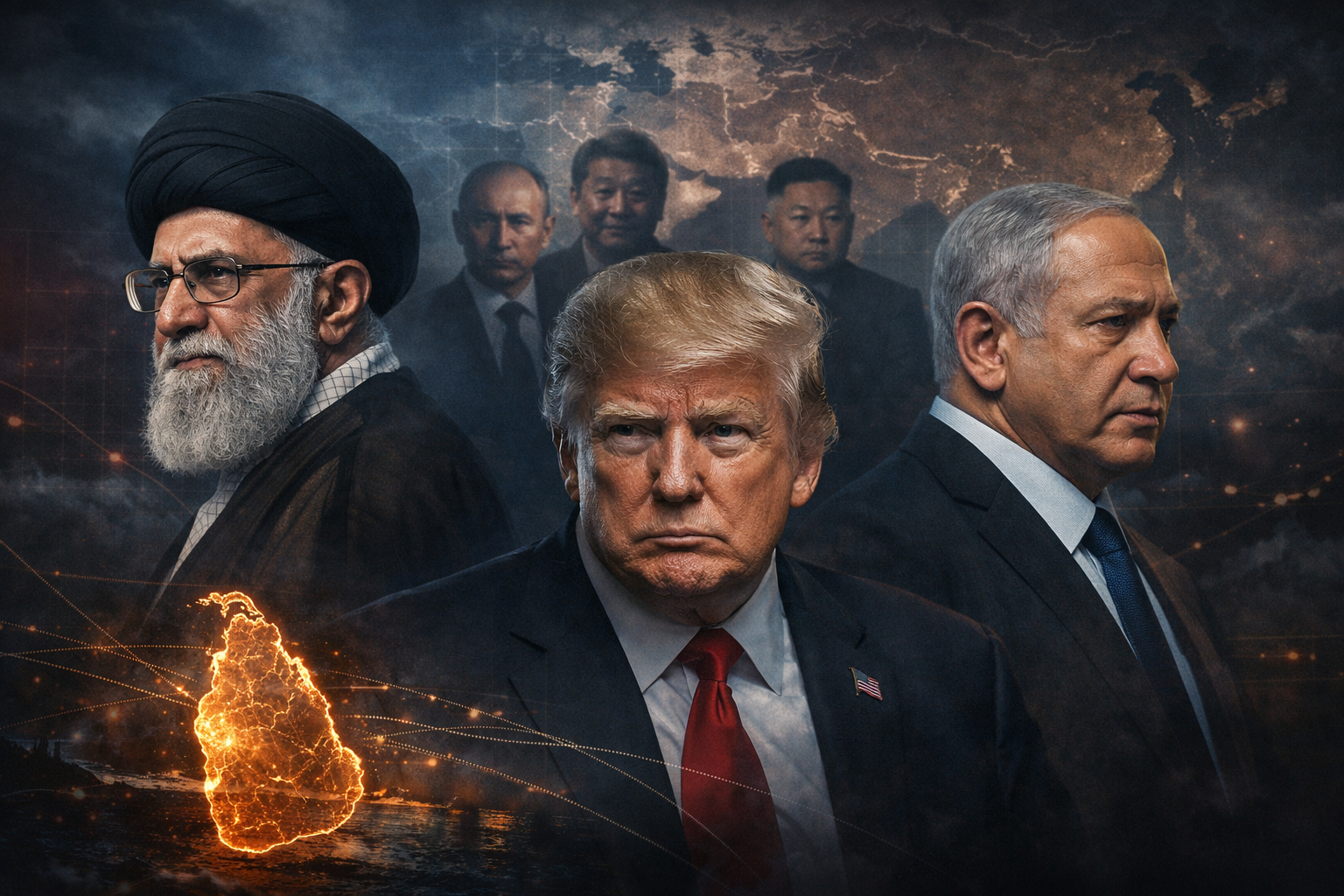
A psychologist's analysis of why nations choose violence, what drives ordinary people to support war, and what the unfolding Iran-Israel-US conflict reveals about the most dangerous aspects of the human mind
Introduction: The World Is Watching — And So Is History
On February 28, 2026, the world woke up to news that changed the shape of the Middle East permanently. The United States and Israel launched a major joint assault on Iran, killing Iran's longtime Supreme Leader Ayatollah Ali Khamenei, and thrusting the country into profound uncertainty. CNN Iran retaliated, firing missiles at Israel and US military bases in multiple Gulf states, with governments in Bahrain, Kuwait, Jordan, Qatar, and the United Arab Emirates all reporting they had been targeted. Council on Foreign Relations
For people watching from Sri Lanka — a nation that has lived through its own devastating civil war — these events carry a particular weight. We know what happens when conflict escalates beyond the point of return. We know what it costs in lives, in families, in the psychological wounds that outlast the last bullet.
But what most news coverage does not ask — and what psychology is uniquely positioned to answer — is this: how does it come to this? What happens inside the human mind, inside political systems, inside entire populations that takes a world from tension to open warfare? What psychological forces are at work when nations choose bombs over negotiation, when leaders choose destruction over diplomacy, when ordinary people find themselves supporting violence they would never personally commit?
This blog does not take political sides. It does not declare who is right or wrong in the Iran-Israel-US conflict. What it does is apply the lens of psychological science to one of the most serious geopolitical crises of our time — because understanding the psychology of war is one of the most important things we can do if we genuinely want less of it.
Part 1: How War Mentality Builds — The Psychological Architecture of Conflict
War does not arrive suddenly. It is built — slowly, systematically, often invisibly — through a series of psychological processes that operate at the individual, social, and institutional level simultaneously. By the time the first missile is fired, the psychological groundwork has been laid for years, sometimes for generations.
Understanding this architecture is essential.
Threat Perception and the Survival Brain
At its most fundamental level, war begins in the part of the human brain designed for survival. The amygdala — the brain's threat-detection center — is extraordinarily powerful and extraordinarily prone to error. It was designed for immediate, physical threats: the predator in the grass, the enemy at the border. It was not designed for the complex, ambiguous, long-range threats that characterize modern geopolitical conflict.
When political leaders communicate that a nation poses an existential threat, they are speaking directly to the amygdala of every citizen who hears them. The brain does not easily distinguish between a real, immediate danger and a constructed, political one. Fear, once activated, narrows thinking dramatically. It reduces cognitive flexibility, increases the appeal of strong authoritarian responses, and makes nuanced, diplomatic thinking feel dangerously slow.
In his State of the Union address just days before the strikes, President Trump described Iran as developing missiles that would "soon reach the United States of America" and warned that the US was prepared to act. Wikipedia Whatever the strategic accuracy of this claim, its psychological function is precise: to activate the threat-response system in the American public and create the emotional conditions in which military action feels not merely justified but urgently necessary.
This is not unique to any one leader or political system. Every government that has ever led its people into war has used some version of this mechanism. The threat is named, amplified, and made to feel immediate — because a population that does not feel threatened does not support war.
In-Group and Out-Group Psychology
One of the most powerful and dangerous features of the human mind is its tendency to divide the world into "us" and "them." This in-group/out-group dynamic has deep evolutionary roots — for most of human history, your survival depended on your group, and the instinct to protect in-group members while viewing out-group members with suspicion had genuine survival value.
In the modern world, this instinct is systematically exploited in the construction of war mentality. National identity, religious identity, and ethnic identity are all mobilized to define who belongs to "us" and who belongs to "them." Once this division is firmly established in the public mind, the psychological barriers to violence against the out-group are dramatically lowered.
The Iran-Israel conflict is one of the most psychologically charged in-group/out-group dynamics in modern geopolitics. Decades of identity construction on all sides have created populations that see each other not as human beings with competing interests but as existential threats to everything that matters. Netanyahu has long framed Iran as Israel's most dangerous adversary — not merely a political opponent but a regime that has called for Israel's elimination. CNN Iranian state ideology has, for decades, defined the United States as the "Great Satan" and Israel in similarly dehumanizing terms. These are not just political positions. They are deeply embedded psychological realities for millions of people on all sides.
Dehumanization — The Most Dangerous Step
Psychologist David Livingstone Smith has written extensively on what he calls the psychology of dehumanization — the process by which one group of human beings comes to see another as something less than fully human. His research, and that of many others, demonstrates that dehumanization is not merely a consequence of war. It is a precondition of it.
Human beings have a natural resistance to killing other human beings. This resistance is not absolute — history has demonstrated that under the right conditions, ordinary people are capable of extraordinary violence. But it is real, and overcoming it typically requires a process of psychological distancing from the humanity of the potential victim.
When propaganda portrays an enemy as barbaric, as a cancer, as a disease that must be eliminated — when language consistently removes the individual humanity of the people on the other side — it performs the psychological function of making violence easier to contemplate. Not just for soldiers, but for the populations that support them.
This process is visible on all sides of the current conflict. It has been building for decades. And it is one of the reasons this crisis has arrived at the point it has.
Part 2: Why Ordinary People Support War — The Psychology of the Public
The leaders who launch wars cannot do so without public support — or at least public acquiescence. Understanding why ordinary people, who will rarely benefit from war and may directly suffer from it, come to support it is one of the most important questions in political psychology.
Fear is the Most Powerful Motivator
Research consistently shows that fear is the single most powerful driver of public support for military action. When people are frightened — genuinely or through constructed threat narratives — they show increased preference for strong, aggressive leaders and decisive, forceful responses. The nuance, patience, and tolerance for ambiguity that effective diplomacy requires become psychologically unappealing when threat is activated.
This is why the communication strategy preceding military action almost always centers on threat amplification. Trump's announcement framed the strikes as defensive, saying Iran had rejected "every opportunity to renounce nuclear ambitions" and that action was necessary to "defend the American people by eliminating imminent threats." CNN Whether accurate or not, this framing positions the attack not as aggression but as protection — a framing the survival brain accepts with relief.
Propaganda, Media, and the Manufacturing of Consent
No modern war happens without an information campaign. The psychological architecture of public support for war is built through the media narratives that citizens consume in the months and years before conflict erupts. Which stories are told and which are omitted. Which suffering is visible and which is invisible. Whose humanity is centered and whose is peripheral.
In the current conflict, social media has added an entirely new dimension to information warfare. Competing narratives — some accurate, some false, many deliberately constructed — reach hundreds of millions of people simultaneously, each algorithmically optimized to trigger maximum emotional response. The human brain, which was not designed to process information at this speed or scale, is overwhelmed. It falls back on heuristics — simple rules of thumb, tribal loyalties, emotional responses — rather than careful analysis.
The result is populations that feel they know what is happening with great certainty, while actually understanding very little of the full complexity. Certainty in the absence of genuine understanding is one of the most dangerous psychological states a population can occupy.
Moral Licensing and Just War Narratives
Human beings are deeply motivated to see themselves as moral actors. We do not support violence because we are cruel. We support it because we have been given a moral framework that makes it feel not just acceptable but righteous.
The just war narrative — the idea that this particular conflict is not merely necessary but morally obligatory — is essential to maintaining public support. Netanyahu stated that Israel and the United States launched strikes on Iran to "remove the existential threat" posed by what he called "the terror regime." Council on Foreign Relations Trump framed the confrontation as the culmination of a 47-year adversarial relationship between the US and Iran, arguing that the Islamic Republic has consistently undermined US interests and destabilized the region. Chatham House
These are moral arguments, not merely strategic ones. They ask citizens to understand violence not as a failure of humanity but as an expression of its highest values — the protection of the innocent, the elimination of genuine evil. Once this moral licensing is in place, opposition to war becomes psychologically difficult — to oppose the war feels like supporting the threat it claims to address.
Part 3: The Psychology of Political Leadership in War
Wars are not made by populations. They are made by leaders — and the psychology of those leaders matters enormously.
Motivated Reasoning and Confirmation Bias
Political leaders, like all human beings, are subject to cognitive biases that distort their perception of reality. Motivated reasoning — the tendency to evaluate evidence in ways that support pre-existing conclusions — is particularly dangerous in conflict situations. When a leader has already decided that military action is necessary, they will unconsciously interpret ambiguous intelligence as confirmation of threat, discount information that suggests diplomatic alternatives, and surround themselves with advisers who share their conclusions.
Intelligence assessments suggested that Iran's nuclear program had been significantly degraded by earlier strikes, yet the discovery of hidden enriched uranium in an undamaged underground facility provided the intelligence trigger that enabled the decision to act. CNN The question that psychology asks — and that is rarely asked in real time — is whether decision-makers were genuinely responding to new information or whether they were looking for information that justified a decision already made.
The Gambler's Fallacy and Escalation Commitment
One of the most dangerous cognitive biases in conflict situations is what psychologists call escalation of commitment — the tendency to continue investing in a course of action because of what has already been invested, even when evidence suggests the course is failing. This is sometimes called the sunk cost fallacy.
In military conflict, this manifests as the logic that "we have already sacrificed too much to stop now." The psychological inability to accept that past sacrifices were made in pursuit of an unachievable goal drives leaders and populations deeper into conflicts that serve no one.
Israel and Iran have been in escalating conflict since 1985, through two direct strikes in 2024, a 12-day war in 2025, and now a major offensive in 2026. Encyclopedia Britannica Each escalation creates the psychological conditions for the next. The investment of blood, treasure, and national identity makes de-escalation feel like defeat — and defeat, in the psychology of national identity, is almost unbearable.
Narcissism, Legacy, and the Personal Psychology of War Leaders
It would be psychologically incomplete to discuss leadership in conflict without acknowledging the role of individual personality. Research on authoritarian leadership and political psychology consistently shows that leaders with narcissistic traits — grandiosity, low empathy, sensitivity to humiliation, a need for dominance — are significantly more likely to lead their nations into conflict.
War is, among other things, a legacy-defining event. For leaders whose psychological identity is organized around strength, dominance, and historical significance, the temptation to use military force as a vehicle for personal legacy can distort strategic decision-making in ways that are profoundly dangerous.
This is not a statement about any particular leader in the current conflict. It is a structural observation about how individual psychology interacts with institutional power at the highest levels.
Part 4: Historical Trauma and the Wounds That Drive Present Conflict
One of the most important and least discussed psychological dimensions of the Iran-Israel-US conflict is the role of historical trauma — the unhealed wounds of the past that shape present perception and behavior in ways that are rarely consciously acknowledged.
Israel's Existential Trauma
The psychological reality of Israel as a nation cannot be understood without understanding the Holocaust — the systematic murder of six million Jewish people that preceded Israel's founding and that remains the central organizing trauma of Israeli national consciousness. A nation born from genocide carries that experience into every subsequent threat assessment. The question that shapes Israeli strategic psychology is not merely "Is this threat real?" It is "What happens to our people if we are wrong?"
This is not a justification for any particular military action. It is a psychological reality that must be understood to make sense of Israeli decision-making. When Iranian leadership has used eliminationist language about Israel, it activates a trauma response in Israeli national psychology that is not primarily strategic — it is existential. And existential fear produces a very different quality of decision-making than calculated strategic interest.
Iran's Humiliation and Revolutionary Identity
Iran's national psychological landscape is equally shaped by historical wounds — the 1953 CIA-orchestrated coup that removed the democratically elected Prime Minister Mohammad Mosaddegh and reinstated the Shah; decades of Western interference in Iranian affairs; the devastating Iran-Iraq War of the 1980s in which Western powers supported Saddam Hussein. These experiences created a national psychology organized around the experience of humiliation, sovereignty violation, and the belief that powerful foreign nations will always ultimately work against Iranian interests.
Trump framed the current conflict as the culmination of a 47-year adversarial relationship dating back to 1979 Chatham House — the year of the Islamic Revolution, which was itself a response to decades of perceived foreign domination. The psychological DNA of that revolution — its anti-imperialist identity, its fierce insistence on sovereignty, its construction of national meaning through resistance to foreign power — continues to shape Iranian decision-making in ways that make certain compromises feel not just politically difficult but psychologically impossible.
The United States — Exceptional and Exhausted
American psychology in the realm of foreign policy is shaped by its own particular mythology — the idea of American exceptionalism, the belief that the United States not only has the right but the responsibility to shape global order. This mythology creates a psychological permission structure for military intervention that other nations do not share, and it coexists with a deep public exhaustion from two decades of Middle Eastern wars that achieved none of their stated objectives at enormous human and financial cost.
Trump himself campaigned against regime change wars and was sharply critical of the 2003 invasion of Iraq, yet found himself launching an operation that analysts immediately compared to that very war. Chatham House The psychological tension between the stated values and the actual behavior points to the power of structural forces — geopolitical pressures, alliance obligations, intelligence imperatives — that shape decision-making in ways that individual conviction often cannot override.
Part 5: The Civilian Population — Ordinary People in Extraordinary Terror
War is experienced most completely not by the leaders who launch it but by the ordinary people caught within it. The psychological impact of war on civilian populations is profound, lasting, and massively underrepresented in political discourse.
Acute Stress and Collective Trauma
The strikes began in daylight on a Saturday morning — the first day of the work week in Iran — as millions went to work or school. CNN Imagine the psychological reality of that moment. People beginning an ordinary day — parents dropping children at school, workers commuting, students studying — when their world erupts into violence with no warning and no preparation.
The acute psychological response to sudden violent threat — the fight-flight-freeze response governed by the sympathetic nervous system — is the same in every human being regardless of nationality, ideology, or political position. Terror does not ask which side you are on. The child in Tehran and the child in Tel Aviv experience the same neurological reality when missiles fall near their homes.
Beginning in late December 2025, massive nationwide anti-government protests had erupted in Iran, driven by economic crisis, the collapse of the currency, and rising prices. The Iranian government responded with violent repression, with estimates of thousands of protesters killed. Wikipedia These were ordinary Iranian citizens — not soldiers, not politicians — who had been living under compounding psychological stress long before the international military conflict arrived. A population already traumatized by economic collapse, political repression, and the grief of mass civilian deaths is now also under military attack.
Collective trauma of this magnitude does not heal quickly. Research on post-conflict societies consistently shows that the psychological wounds of war — the PTSD, the complicated grief, the erosion of trust, the generational transmission of fear and anger — outlast the physical destruction by decades. Sri Lankans know this reality intimately.
The Protest Movement and the Psychology of Courage
The protests that erupted across Iran became the largest in scale since the 1979 revolution, spreading to over 100 cities. Encyclopedia Britannica The psychology of protest under authoritarian repression is one of the most remarkable phenomena in human behavior — the willingness to risk your physical safety, and in this case your life, in pursuit of political change that you may not live to see.
What drives this courage? Research in political psychology points to a combination of factors: the accumulation of unbearable humiliation that eventually overrides fear; the social contagion of collective action, where seeing others act creates a psychological permission to act yourself; and the deep human need for dignity — the sense that some conditions of living are simply incompatible with being a full human being.
The Iranian protesters were not abstractions. They were engineers and teachers and students and mothers who decided that something mattered more than their survival. The psychological complexity of their situation — caught between a repressive regime, international military action, and the hope of a different future — deserves to be seen in its full human weight.
Part 6: The Role of Media and Social Media in Accelerating War Mentality
No analysis of the psychology of the current conflict is complete without examining the role of media — both traditional and social — in shaping public consciousness about war.
We live in an information environment that is uniquely poorly suited to the kind of careful, nuanced thinking that conflict situations require. Social media algorithms reward emotional content — anger, fear, outrage — over analytical content. The human brain, wired for tribal loyalty and threat response, is particularly susceptible to information that confirms existing beliefs and provokes strong emotional reactions.
The result is that millions of people around the world are forming strong opinions about an extraordinarily complex geopolitical situation based on a combination of algorithmically selected emotional content, state propaganda from multiple directions, and the tribal loyalties of their existing communities. The psychological certainty with which people hold these opinions is inversely related to the actual complexity of the situation.
This is not a neutral phenomenon. Public opinion shapes political possibility. When populations have been psychologically prepared — through fear, moral licensing, and dehumanization of the other — to support military action, the political space for diplomacy contracts. When populations can hold complexity, demand accountability, and maintain empathy for civilians on all sides, the political space for non-violent resolution expands.
Media literacy — the psychological capacity to evaluate information critically, to recognize manipulation, to maintain empathy across tribal lines — is not a luxury. In the current information environment, it is one of the most important public health interventions available.
Part 7: De-escalation — What Psychology Tells Us About Preventing War
If psychology helps explain how war mentality builds, it also offers genuine insight into how it can be interrupted — and how conflicts can be de-escalated before and after they begin.
Contact Hypothesis and Humanization
One of the most replicated findings in social psychology is the contact hypothesis — the finding that meaningful personal contact between members of opposing groups is one of the most effective ways of reducing prejudice and hostility. When we know individual members of the "out-group" as real human beings — with families, fears, humor, and ordinary daily lives — the dehumanizing narratives that support violence become psychologically harder to sustain.
This is why cultural exchange, journalism that centers the humanity of civilian populations on all sides, and the voices of ordinary people rather than just political leaders are not merely nice additions to conflict coverage. They are psychologically essential counterweights to the dehumanization that makes war possible.
The Psychology of Negotiation and Face-Saving
Nuclear talks between Iran and the United States had reportedly been making significant progress in the days before the strikes, with Iran agreeing "never" to stockpile enriched uranium. CNN Oman's Foreign Minister, who had acted as mediator, said there had been "significant" progress — yet this was not enough to prevent military action. Al Jazeera
This is a psychologically painful reality. Diplomatic progress and military action are not always opposites — sometimes the perception of diplomatic vulnerability actually accelerates military decision-making, as adversaries seek to act before negotiated constraints are fully established.
Effective de-escalation requires understanding the psychological needs of all parties — not just their stated political positions. What does each party need in order to feel that a negotiated outcome preserves their dignity, their security, and their identity? Face-saving — the ability to accept compromise without experiencing it as humiliation — is not a trivial consideration. It is often the deciding factor between war and peace.
Citizen Psychology and the Demand for Peace
The global reaction to the strikes included widespread calls for restraint, with the EU urging "maximum restraint" and multiple governments calling for an emergency UN Security Council meeting. Al Jazeera The international community's response reflects a global psychological reality — the vast majority of ordinary human beings, regardless of nationality, do not want war. They want safety, dignity, economic security, and the ability to live their lives without fear.
The psychological distance between what ordinary people want and what political systems produce is one of the defining tensions of modern democracy. Closing that distance — through genuine civic engagement, through demanding accountability from political leaders, through refusing the psychological manipulation of threat inflation and dehumanization — is not just a political act. It is a psychological one.
Part 8: What This Means for Sri Lanka — A Nation That Knows the Cost
Sri Lanka watches the Iran-Israel-US conflict with the particular attention of a nation that has lived through its own devastating civil war. For almost thirty years, this country experienced firsthand what happens when political conflict becomes military conflict, when ethnic and religious identity is weaponized, when ordinary people pay the price for decisions made by leaders who will not personally bear the cost.
The psychological lessons of our own civil war are directly applicable to what we are watching unfold in the Middle East. We know that wars are easier to start than to stop. We know that the trauma inflicted on civilian populations lasts for generations. We know that the children who grow up under military conflict carry wounds that shape who they become and what they do — and what their children do.
We also know that peace is possible. That even the most seemingly intractable conflicts — conflicts rooted in deep historical wounds, identity politics, and decades of accumulated grievance — can be transformed. Not easily. Not quickly. Not without genuine courage and genuine loss. But it can be done.
The psychological capacity for peace is as human as the psychological capacity for war. The question is always which one receives more investment — in political will, in cultural narrative, in the everyday choices of ordinary citizens about how to see the people on the other side of whatever divide their society has constructed.
Conclusion: The Most Important Battlefield Is the Human Mind
The missiles that fell on Tehran on February 28, 2026, were the visible, physical culmination of psychological processes that had been building for decades. The fear, the historical trauma, the in-group loyalties, the dehumanization, the motivated reasoning of leaders, the manufactured consent of populations — all of it preceded the physical conflict and made it possible.
This does not mean the conflict was inevitable. Nothing in human psychology is inevitable. Every psychological process that leads toward war has a counterpart that leads away from it. Fear can be met with genuine security-building rather than threat amplification. Historical trauma can be acknowledged and processed rather than weaponized. Dehumanization can be countered by the stubborn insistence on seeing the humanity in every person caught in the crossfire.
As the world watches the Iran-Israel-US conflict with anxiety and grief, the question that psychology asks is not simply "Who is winning?" It is "What are we learning?" Are we allowing fear and tribal loyalty to narrow our thinking, or are we maintaining the psychological complexity required to see all the human beings involved — not just the ones on our side?
The most dangerous weapon in any war is not a missile or a nuclear facility. It is a human mind that has been successfully convinced that the people on the other side are not fully human.
And the most powerful act of resistance against war — available to every one of us, regardless of our nationality, our politics, or our power — is the daily, deliberate choice to refuse that conviction.