By Persona Mind | Mental Wellness & Psychoanalytic Insights
Have you ever sat across from your partner during an argument and thought to yourself, "Why does this keep happening to us?" Have you ever caught yourself reacting to something your spouse said with an intensity that surprised even you — a flash of anger, a wave of hurt, a sudden urge to shut down and go silent — and wondered where on earth that came from?
Or perhaps you have watched your children and noticed, with a quiet unease, that they are beginning to mirror some of the same emotional habits you swore you would never pass on?
If any of this feels familiar, you are not alone — and you are not failing. What you are experiencing is one of the most universal and least talked-about aspects of human relationships: the profound, invisible influence of our earliest years on every relationship we build as adults.
At Persona Mind, this is the work we are most deeply committed to — helping individuals and families understand the hidden psychological forces that shape their closest bonds, so they can begin to build something genuinely different. Something healthier, warmer, and more free.
Because here is the truth that changes everything: most of the conflicts threatening our marriages and families today were not born in the present. They were written in childhood. And what was written can, with courage and the right support, be rewritten.
You Never Really Marry Just One Person
Let's begin with something that might surprise you.
When two people stand together and declare their love — in a ceremony, in a courthouse, or simply in the quiet commitment of choosing each other — they believe they are making a choice between two individuals. Two personalities. Two sets of preferences and quirks and dreams.
But from a psychoanalytic perspective, the reality is far more layered than that.
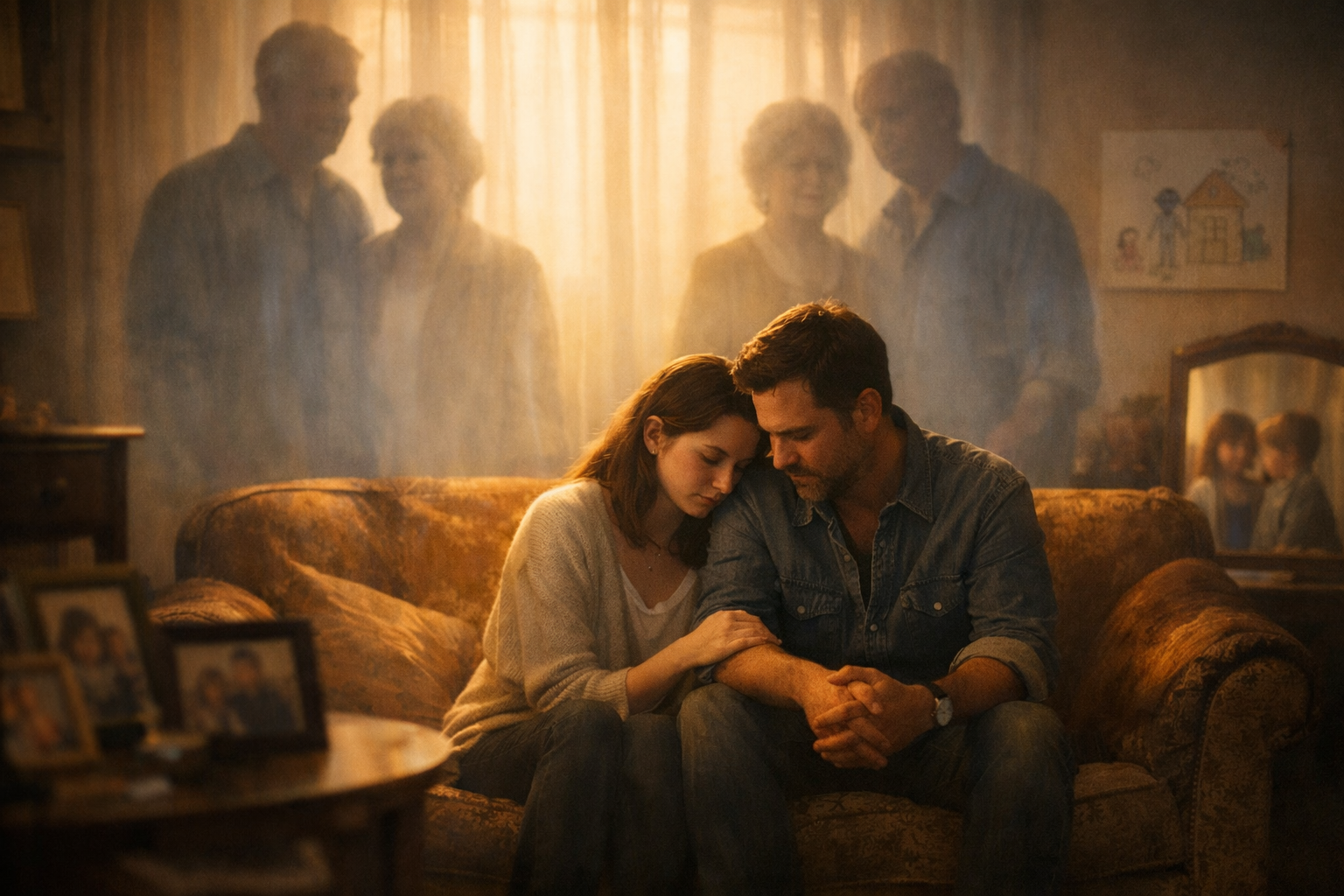
When you marry your partner, you are not just marrying them. You are marrying the child they once were. You are marrying the ghost of their mother's expectations and the echo of their father's silences. You are marrying the lessons their family home taught them about whether love is safe, whether conflict is survivable, whether they are worthy of tenderness, and whether people who say "I love you" actually stay.
And your partner? They are marrying all of that in you, too.
Every single one of us walks into our adult relationships carrying what psychoanalysts call an Internal Working Model — a deeply embedded, largely unconscious framework built from our earliest experiences of being loved, ignored, comforted, criticized, held, or left alone. This model becomes our emotional operating system. It runs quietly in the background of every relationship we form, telling us what to expect from other people, how much closeness is safe, what we need to do to be loved, and what will inevitably go wrong.
The trouble is, most of us have absolutely no idea this system exists. We believe we are simply reacting to what is happening right now, in the present moment. We believe the argument is about the dishes, or the money, or the fact that our partner forgot something important again. We believe our anxiety about being left is a logical response to something our spouse did this morning.
We rarely stop to ask: Where did this feeling really come from? How old is this wound?
That is the question that changes everything.
The Childhood Blueprint: Where It All Begins
To understand why our adult relationships unfold the way they do, we need to travel back — further back than most of us are comfortable going — to the very beginning.
Sigmund Freud, the father of psychoanalysis, made an observation that has only grown more supported by modern psychology and neuroscience in the decades since: the foundation of human personality, emotional regulation, and relational behavior is largely constructed within the first five to six years of life.
This is not simply a theory. Brain imaging research confirms that the earliest years of life are a period of extraordinary neural development. The emotional experiences a child has during this time — the quality of care they receive, the emotional atmosphere of their home, the way their needs are met or dismissed — are literally wired into the developing brain. They become the child's baseline for what the world feels like and what relationships mean.
Psychoanalysts refer to the internal emotional templates created during this period as Internal Object Relations — the deeply buried, emotionally charged representations of self and other that the child absorbs through their earliest interactions with their caregivers.
In simpler terms: the way we were treated as children becomes our unconscious definition of love itself.
Think about what that means for a moment.
If a child grows up in a home where love was expressed freely — where comfort was consistently offered, where emotional needs were taken seriously, where the child learned that it was safe to be vulnerable — that child develops an internal sense of security. They learn, at the deepest level, that relationships are safe. That they are worthy of care. That closeness does not need to be feared.
But if a child grows up in a home where love was conditional — where affection was withdrawn as punishment, where emotions were ignored or ridiculed, where a parent's moods were unpredictable and frightening — that child learns a very different lesson. They learn that closeness is dangerous. That they must earn love through performance. That showing vulnerability invites pain. That people always leave eventually, so it is safer not to need them too much.
Neither of these children chooses to absorb these lessons. They simply live them, day after day, until they become the invisible architecture of their inner world.
For sons, the emotional quality of their relationship with their mother — her warmth or her emotional unavailability, her consistency or her unpredictability, the way she responded to his needs and feelings — quietly and profoundly shapes his unconscious understanding of what women are like, what intimacy feels like, and what he must do to be loved by a woman. He carries this template forward into every romantic relationship, often without any conscious awareness of its existence.
For daughters, the reliability, emotional presence, and protection offered by their father — or the painful absence of these things — becomes the foundation of her capacity to trust men. If her father was emotionally present and steady, she learns that men can be counted on. If he was distant, volatile, or absent, her nervous system learns to brace for the same from every man who follows. Her guard, however exhausting, feels like survival.
When these two individuals — each carrying their own invisible blueprint, each shaped by their own distinct emotional history — come together in a marriage, they do not simply share a life. They bring two entirely different internal worlds into one shared space. And almost inevitably, those worlds collide in ways that neither partner fully understands.
Why Small Arguments Feel So Enormous
This is one of the most common experiences couples bring to our work at Persona Mind — the bewildering, sometimes frightening sensation that an argument that began over something entirely minor has somehow escalated into something that feels catastrophic.
One partner forgets to respond to a message and the other experiences a surge of panic that feels completely out of proportion to the situation. One partner uses a slightly critical tone and the other shuts down completely, going cold and unreachable for hours. A simple disagreement about how to handle a parenting decision somehow becomes a referendum on whether the marriage is working at all.
From the outside, these reactions can look like overreactions — or worse, like emotional immaturity or manipulation. But from a psychoanalytic perspective, they are something far more understandable and far more human than that.
They are triggers. Present-day events that have inadvertently pressed against an old, unhealed wound from the person's original family home.
When your partner's distracted silence sends you into a spiral of anxiety, it is not really their silence you are responding to. You are responding to every time you felt invisible as a child. Every time you needed attention or comfort and found no one there. Their silence in this moment has activated a feeling that is ancient and enormous — and your nervous system is responding to the accumulated weight of all of it, not just tonight's dinner conversation.
When your partner becomes defensive and shuts down the moment you express dissatisfaction, it is not really your feedback they cannot tolerate. It is the ghost of a parent who raged when displeased, or withdrew when their child failed to be perfect. Your critical tone — however gentle — has traveled straight past their adult mind and landed on the child they once were, who learned that disapproval precedes disaster.
Understanding this does not mean that these reactions are acceptable or that they cannot be changed. It means that they make sense. And things that make sense can be worked with. Things that are understood can be transformed.
Repetition Compulsion: The Pattern That Keeps Finding You
There is a concept in psychoanalysis that, once understood, has the power to illuminate an enormous amount of human suffering. Freud called it Repetition Compulsion — and it is one of the most quietly devastating forces at work in our relational lives.
Repetition Compulsion is the unconscious drive to recreate painful past experiences in the present. Not because we enjoy pain — no one consciously seeks suffering — but because the unconscious mind, in its strange and persistent logic, believes that if it can replay the old painful scenario one more time, perhaps this time it will finally achieve a different outcome. Perhaps this time, it will win the love it was denied. Perhaps this time, it will finally feel like enough.
The result is a pattern that many people have experienced but few have been able to name: the sense that no matter how many relationships you enter, you somehow always end up in the same emotional place. The partners change. The circumstances are different. But the feeling — the loneliness, the rejection, the powerlessness, the abandonment — is hauntingly, heartbreakingly familiar.
Consider a man who grew up with a mother who was loving but deeply anxious and controlling — a woman who expressed her love through overprotection and struggled to allow her son any real autonomy. As an adult, this man may find himself repeatedly attracted to strong, opinionated, emotionally intense women. He may initially find this quality exciting and even comforting — it feels like home, in the truest and most literal sense. But over time, he finds himself feeling suffocated, unable to breathe, resentful in ways he cannot fully explain. He leaves the relationship. He meets someone new. And slowly, inexorably, the same dynamic begins to emerge again.
Consider a woman who grew up with an emotionally absent father — a man who was present in the household but never truly there. Never emotionally engaged, never truly seen her, never made her feel that she was the kind of person worth really knowing. As an adult, this woman may find herself drawn again and again to partners who are emotionally unavailable — men who are preoccupied, withholding, or simply incapable of the depth of connection she craves. Her conscious mind is baffled and frustrated. Her friends shake their heads. But her unconscious is following a very specific, if utterly misguided, mission: if I can finally unlock the love of this distant man — if I can finally be interesting enough, beautiful enough, patient enough, loving enough — then I will heal the wound my father left. I will finally know that I am worth loving.
Without awareness, this journey leads nowhere good. The partners change; the wound does not. And each repetition, rather than healing the original pain, tends to deepen it — adding new layers of disappointment, self-doubt, and grief to something that was already heavy.
This is not a personal failing. It is one of the most human things imaginable. And it is one of the most powerful reasons that self-awareness and professional support matter so profoundly.
The Intergenerational Chain: Pain That Travels Through Time
Now we arrive at perhaps the most urgent dimension of this conversation — the one that extends beyond any individual marriage and reaches forward into the future.
Unresolved psychological pain does not stay contained. It travels.
It moves not through genetics, but through the emotional atmosphere of a household — through the quality of a parent's presence, through the unspoken rules about which emotions are acceptable and which must be hidden, through the way conflict is handled and the way love is expressed, through thousands of small daily interactions that a child absorbs long before they have the language to describe what they are experiencing.
Psychologists and researchers who study intergenerational trauma — the transmission of unresolved emotional pain from one generation to the next — have found evidence of these patterns persisting across three, four, and even five generations of the same family. The same cycles of divorce, the same emotional unavailability, the same explosive anger management, the same suffocating anxiety, the same crushing perfectionism — recurring in family after family, generation after generation, with the participants having no conscious awareness that they are reenacting a script they inherited rather than authored.
How does this transmission happen? Through two primary psychological mechanisms:
Identification is the process through which children unconsciously absorb and internalize the emotional patterns, behaviors, and coping strategies of their primary caregivers. A child does not simply observe their parents from a safe emotional distance — they become what they see. A father who consistently responds to stress with explosive anger teaches his son, without a single explicit lesson, that this is what men do when they feel overwhelmed. A mother who dissolves into anxiety every time a situation feels uncertain teaches her daughter that the world is fundamentally unsafe and unpredictable. These lessons are absorbed at a preverbal, somatic level — they live in the body and the nervous system long before they reach conscious thought.
A child growing up in a home where emotional warmth is scarce learns to suppress their own need for closeness — because needing and not receiving is too painful to bear. They grow up, enter relationships, and find that intimacy terrifies them. They cannot explain why. They do not realize they learned this fear at the age of three.
Projection is equally insidious, and perhaps even more invisible. Parents — especially those who carry significant unresolved wounds of their own — often unconsciously project their own unexpressed needs, unfulfilled dreams, and suppressed fears onto their children. The parent who never felt good enough may raise a child under enormous, unstated pressure to be perfect — not because the parent consciously intends to burden their child, but because the child has become a vessel for the parent's own desperate need to feel adequate. The parent who feared failure may respond to their child's mistakes with a fury that is wildly out of proportion — not because the mistake itself was so terrible, but because it has activated the parent's own deep and unprocessed shame.
The child in these situations grows up carrying a weight they did not choose and cannot name. They feel the pressure, the anxiety, the sense that they are never quite enough — but they attribute it to something essential about themselves rather than something they inherited. They grow up, become parents, and the cycle continues.
At Persona Mind, we call this the Psychological Relay Race. The baton — weighted with anxiety, grief, anger, shame, or silence — is passed from one runner to the next. Generation after generation, the race continues. No one stops to ask where the baton came from or why it is so heavy. They simply run, because running is all they have ever seen anyone do.
But here is the profound and hopeful truth at the heart of all of this: a relay race can be stopped. The baton can be put down. Someone can choose not to pass it on.
That choice is available to you, right now, in this generation.
Breaking the Cycle: The Work of Becoming Free
Breaking a generational pattern is not simple work. It requires honesty, courage, patience, and usually a great deal of support. But it is absolutely possible — and it may be the most meaningful thing you ever do, not just for yourself, but for everyone who comes after you.
At Persona Mind, we have walked alongside many individuals and couples as they undertook this transformation. And while every person's journey is unique, we have found that the path forward consistently involves three essential dimensions of inner work:
Step One: Developing Insight — Learning to See What Has Always Been There
The first and most foundational step is the development of genuine psychological insight — the courageous and compassionate willingness to look inward and begin to understand the invisible forces that have been driving your behavior and your emotional responses.
This means cultivating what therapists call the observing ego — the part of you that can step back from your immediate emotional reactions and witness them with some degree of curiosity rather than simply being swept away by them. It means learning to pause in the midst of a strong emotional reaction and ask: What is actually happening inside me right now? What does this feeling remind me of? How old do I feel in this moment? Is my reaction truly proportionate to what is happening in front of me — or is some older, deeper hurt being activated?
It also means beginning to trace the origins of your relational patterns. When you notice that you consistently struggle with the same issues in relationships — difficulty with trust, a tendency to abandon your own needs, an intense fear of conflict or an inability to back down from it, a pattern of choosing partners who are ultimately unavailable — begin to ask: Where did I first learn this? What did my earliest experiences of love and relationship teach me about how this works?
This is not about assigning blame to your parents. In the vast majority of cases, they too were operating from their own unexamined blueprints, their own inherited pain. Understanding the source of your patterns is not about creating villains — it is about creating freedom. Because a pattern you can see is a pattern you can begin to change.
Step Two: Mourning the Past — Giving Yourself Permission to Grieve
This is the step that most people resist most strongly — and it is, in many ways, the most transformative.
Mourning the past means allowing yourself to fully acknowledge and feel the grief of what you did not receive in childhood. It means sitting with the painful truth that your childhood was not perfect — that you were let down in real ways by real people, even people who loved you — and allowing yourself to feel the sadness, the anger, and the loss of that reality without rushing to minimize it or explain it away.
Many people find this step profoundly uncomfortable, for several reasons. Some feel that grieving their childhood means betraying their parents — people they love, people who sacrificed for them, people who did their best. Others have spent so long minimizing or denying their pain that the thought of truly feeling it feels overwhelming, even dangerous.
But here is what unacknowledged grief does: it quietly relocates. When we don't grieve the love we didn't receive in childhood, we don't move past the need for it — we simply begin to seek it from our adult relationships. We unconsciously turn to our partners with needs and longings that belong to the past, placing impossible demands on them to repair wounds they did not cause and cannot heal. We turn to our children — our own precious, innocent children — and burden them with the task of making us feel worthy, needed, or finally enough.
When we truly grieve the past — when we allow ourselves to acknowledge, with compassion and without judgment, what was missing and how it hurt — we do something extraordinary: we free our present relationships from the burden of being asked to fix what happened decades ago. We can love our partners and our children for who they actually are, rather than using them as instruments of our own unfinished healing.
This grief does not arrive all at once, and it does not resolve in a single therapeutic session. It unfolds gradually, in layers, over time. But every layer that is genuinely processed is a layer that no longer needs to be carried forward.
Step Three: Professional Intervention — The Courage to Ask for Support
There are limits to what self-reflection alone can achieve. Some patterns are too deeply embedded, too well-defended, and too old to be fully accessed through conscious effort. They live below the threshold of ordinary awareness — in the body, in the nervous system, in the automatic reactions that happen before the thinking mind has a chance to intervene.
This is precisely where psychoanalytic therapy and professional psychological support become not just helpful, but genuinely transformative.
Working with a skilled therapist provides something that is very difficult to create on your own: a safe, boundaried, consistently available relationship within which you can begin to examine your childhood blueprint without the fear of judgment or abandonment. The therapeutic relationship itself becomes a kind of laboratory — a space where old relational patterns emerge organically and can be observed, understood, and gently worked through in real time.
In therapy, you are not simply talking about your problems. You are experiencing something different — a relationship that does not react the way your original family did, that does not punish vulnerability or reward performance, that remains steady and present even when the material becomes painful. This experience, over time, begins to create new neural pathways. It begins to offer your nervous system evidence that relationships can be safe — that you can be truly known and not abandoned, that your needs are not a burden, that you are worthy of genuine care.
Couples therapy offers a parallel gift — the opportunity for both partners to begin to understand each other's childhood blueprints, to develop compassion for the invisible wounds each is carrying, and to learn how to be present for each other in ways that are genuinely healing rather than inadvertently retraumatizing.
Seeking professional support is not a sign of weakness or failure. It is one of the most clear-eyed, courageous, and loving decisions a person can make — for themselves, for their relationship, and for every generation that will follow.
What Healing Actually Looks Like
We want to be honest with you about something, because we believe you deserve honesty more than you deserve comfortable platitudes.
Healing is not a destination you arrive at once and then inhabit forever. It is not the permanent elimination of all emotional reactivity or relational difficulty. It is not the achievement of some ideal state of perfect psychological health.
Healing is a practice. It is the ongoing, daily, imperfect commitment to showing up with greater awareness, greater compassion, and greater intentionality than you did yesterday.
It looks like catching yourself in an old pattern — the familiar shutdown, the defensive snap, the anxious spiral — and pausing long enough to ask: What is actually happening inside me right now? It looks like choosing to have the difficult conversation instead of falling back into the old silence. It looks like reaching for your partner's hand even when the child inside you wants to pull away. It looks like saying to your own child, "I'm sorry, I got that wrong. Let me try again" — and meaning it.
It looks like sitting with your own discomfort long enough to choose a different response. Not perfectly. Not always. But with increasing frequency, increasing grace, and increasing love.
That is healing. And it is available to you.
A Letter to the Generation That Chooses to Stop the Relay Race
To every parent reading this who has looked at their child and felt the ache of wanting something better for them than what they received — this is for you.
To every partner who has felt the sorrow of watching the same painful dynamic play out again and feeling powerless to stop it — this is for you.
To every person who has sat alone with the quiet, heavy knowledge that something from their past is shaping their present in ways they don't fully understand — this is for you.
You did not choose the baton you were handed. You did not design the blueprint you were given. The patterns you are carrying were written before you had any say in the matter, by people who were themselves carrying patterns they didn't choose.
But you are here, reading these words, asking these questions. And that matters more than you know.
The moment you begin to see the pattern is the moment you step outside of it. Not all the way — healing is a journey, not a single step. But the awareness itself is transformative. It is the difference between being unconsciously driven by your past and consciously choosing your future.
The baton that your children receive from you does not have to weigh what yours did. It can be lighter. It can carry the warmth of emotional honesty, the steadiness of a parent who knows their own wounds and tends to them, the extraordinary gift of a family culture where feelings are safe, needs are valid, and love does not have to be earned.
That is the inheritance you have the power to create. And it begins with the decision to understand yourself — honestly, compassionately, and with as much professional support as you need.
Final Thoughts: The Greatest Investment You Will Ever Make
At Persona Mind, we believe deeply in the capacity of every person to grow, to heal, and to build relationships that are genuinely nourishing — not because life has been easy, but because they have done the courageous work of understanding themselves.
The path we have walked through together in this piece — from the childhood blueprint to repetition compulsion, from intergenerational transmission to the work of breaking the cycle — is not simply an academic framework. It is a map. And like any map, its value lies not in studying it, but in using it.
If something in these pages has resonated with you — if you have recognized yourself, your relationship, your family of origin, or your own children in any of what we have described — we want you to know that what you are feeling is not despair. It is the beginning of clarity. And clarity, as painful as it can sometimes be, is always the beginning of change.
Your past does not have to be your children's future. The patterns that have held your family for generations do not have to hold the generations that come next. The cycle can end with you — not because you are perfect, but because you are willing.
That willingness is enough to begin.
At Persona Mind, we offer individual therapy, couples counseling, and family psychological support grounded in psychoanalytic principles and modern evidence-based practice. Our team of licensed psychologists and counselors is here to walk alongside you — at whatever stage of the journey you find yourself.
You don't have to carry this alone.
Persona Mind — Empowering Your Mind for a Healthier Tomorrow.