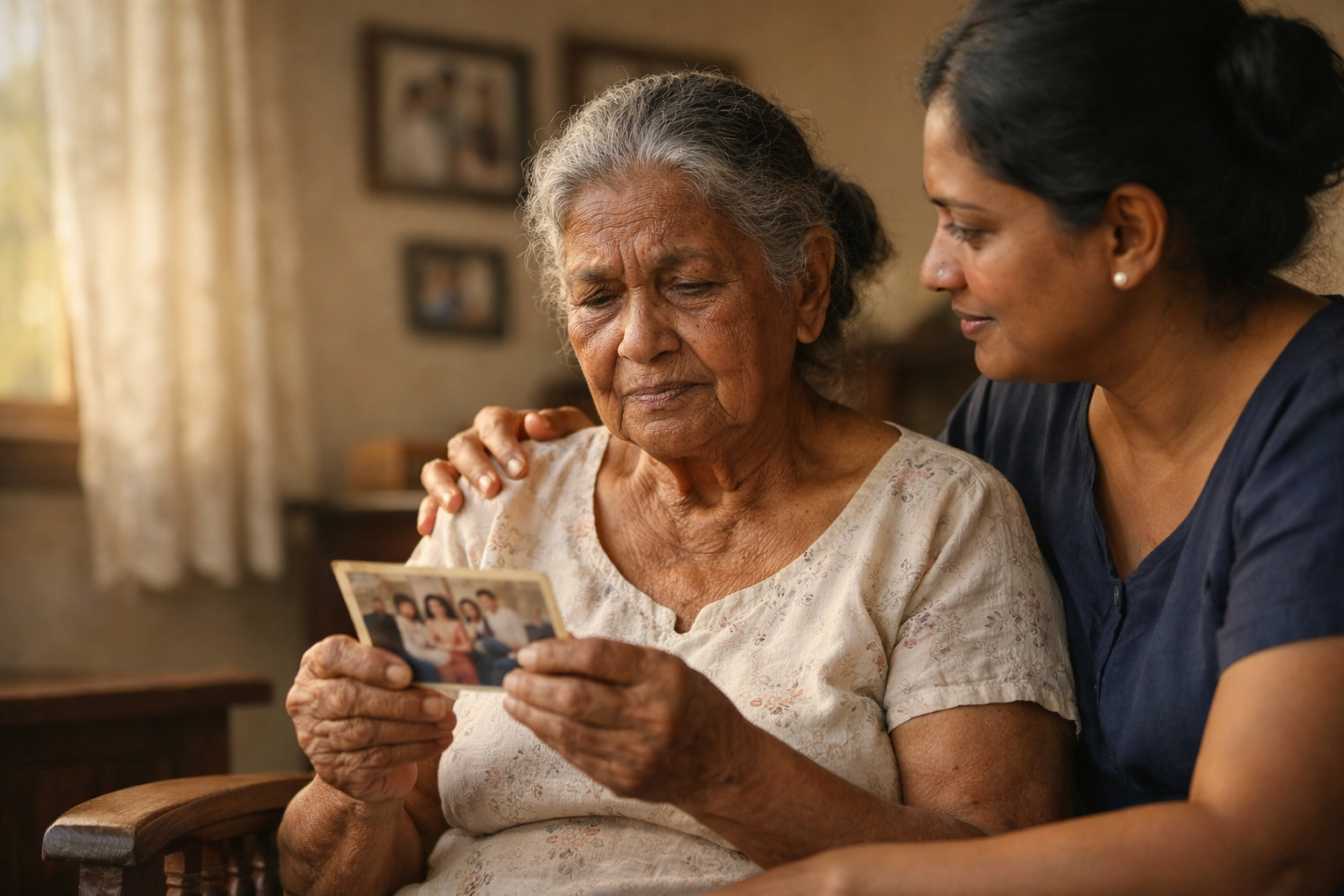
There is a particular kind of grief that has no name in most languages.
It is the grief of watching someone you love still breathing, still sitting across the table from you, still present in body — and yet somehow, slowly, becoming a stranger. The grief of a mother who no longer remembers your name. A father who looks at you with kind but empty eyes. A grandmother who calls out for people who left this world decades ago, as though they were just in the next room.
This is the quiet, devastating reality that thousands of Sri Lankan families are living with right now. And most of them are living with it in silence — because we do not talk about dementia. Not in our homes. Not in our communities. Not even in most of our hospitals, with the seriousness it deserves.
This needs to change. And it starts with understanding what dementia actually is — not as a vague, frightening word, but as a real, medical, psychological condition that can be recognised, managed, and in some cases, meaningfully slowed.
What Is Dementia? Not Just Forgetting
The first and most important thing to understand is this: dementia is not normal ageing.
We all forget things as we grow older. A name slips the mind. We walk into a room and momentarily forget why. We misplace our keys. This is ordinary. This is the brain ageing, as all organs age, with a gradual reduction in processing speed and memory efficiency.
Dementia is something fundamentally different.
Dementia is not a single disease. It is an umbrella term for a group of symptoms caused by physical changes in the brain — changes that progressively damage brain cells, disrupt the connections between them, and over time, erode the functions that make us who we are: memory, language, reasoning, personality, and the ability to perform the basic tasks of daily life.
The most common form is Alzheimer's disease, which accounts for approximately 60 to 70 percent of all dementia cases globally. Others include vascular dementia — caused by reduced blood flow to the brain, often following a stroke — Lewy body dementia, and frontotemporal dementia, each affecting different regions of the brain and producing different patterns of deterioration.
What they share is this: they are progressive, they are physical, and they are not the person's fault. Dementia is not a character weakness. It is not a spiritual failing. It is not the result of laziness or lack of mental effort. It is a medical condition — one that deserves the same compassion, the same seriousness, and the same quality of care as any other.
The Warning Signs We Too Often Dismiss
In Sri Lankan families, there is a deeply ingrained tendency to explain the early signs of dementia away. "Ammi is getting old, that's all." "Thaththa has always been forgetful." "It's just stress."
This is understandable. None of us want to believe that something is seriously wrong with someone we love. But this delay — between the appearance of early symptoms and seeking proper evaluation — is one of the most costly patterns in dementia care, because the earlier the condition is identified, the more options exist for managing it.
These are the signs that deserve serious attention — not panic, but prompt, compassionate action:
Memory loss that disrupts daily life. Not occasionally forgetting where you left something, but repeatedly forgetting recently learned information, asking the same questions multiple times in a short period, or becoming increasingly reliant on memory aids for things that were never needed before.
Difficulty with familiar tasks. Struggling to follow a recipe that has been cooked for thirty years. Forgetting how to operate a television remote. Getting lost on a route that has been walked a thousand times.
Confusion about time and place. Losing track not just of dates, but of seasons, years, or the passage of time itself. Not knowing where they are, or how they got there, even in familiar surroundings.
Changes in language. Stopping mid-sentence and being unable to continue. Substituting unusual words for common ones. Repeating the same story or phrase within a single conversation without awareness of having already said it.
Withdrawal from social life. A person who was once engaged, social, and warm gradually retreating — avoiding conversations, giving up hobbies, becoming passive in situations where they were previously active. This is sometimes mistaken for depression, and the two conditions can co-exist, but the pattern deserves attention either way.
Shifts in personality and mood. Becoming unusually suspicious, anxious, or fearful. Displaying emotions that seem disconnected from the situation. Behaving in ways that feel out of character — particularly a loss of the social inhibitions that previously defined how they engaged with others.
One or two of these, in isolation, may have other explanations. But a cluster of these symptoms, appearing together and worsening over time, is not something to wait and see about. It is something to take to a doctor.
What Is Happening Inside the Brain
To understand dementia with any real depth, it helps to understand what is physically happening in the brain as the condition progresses.
The human brain contains approximately 86 billion neurons — nerve cells that communicate with each other through an intricate network of electrical and chemical signals. Every memory you hold, every skill you possess, every aspect of your personality, is encoded in the patterns of connection between these cells.
In Alzheimer's disease — the most common form of dementia — two abnormal structures begin to accumulate in the brain tissue: amyloid plaques, which are clumps of protein that build up between neurons and disrupt communication between them, and neurofibrillary tangles, which are twisted fibres of a protein called tau that accumulate inside neurons and interfere with their internal transport systems. As these structures spread, neurons lose their ability to communicate, begin to malfunction, and eventually die.
The damage typically begins in the hippocampus — the brain region most centrally involved in forming new memories. This is why short-term memory loss is usually the first and most visible symptom. As the disease progresses, it spreads to other regions — the cortex, which manages language and reasoning; the frontal lobes, which govern personality and judgment; eventually the regions that control basic physical functions.
In vascular dementia, the mechanism is different but equally destructive. When blood supply to parts of the brain is repeatedly interrupted — through small strokes, or through the gradual narrowing of blood vessels — brain tissue is deprived of oxygen and begins to die. The symptoms depend on which regions are affected, and the progression can be more step-like than the gradual slope of Alzheimer's.
Understanding this is not morbid. It is clarifying. Because when you understand that the person you love is not choosing to forget you — that the biology of their brain is being physically altered in ways entirely outside their control — something shifts in how you are able to show up for them.
The Cultural Weight Sri Lankan Families Carry
In Sri Lanka, caring for an elderly parent or grandparent is not a question. It is simply what families do. This is one of the most beautiful aspects of our culture — the instinctive orientation toward family, the refusal to abandon our elders to institutional care, the sense that to look after those who looked after us is not a burden but a duty and an honour.
But when that elder has dementia, this beautiful instinct can become quietly crushing — because most families have no preparation, no knowledge, no support, and no framework for understanding what they are witnessing or what it requires of them.
The person with dementia may become agitated, suspicious, or aggressive — not out of cruelty, but out of a terror that comes from experiencing a world that no longer makes consistent sense. They may accuse family members of stealing. They may resist bathing, eating, taking medication. They may wake in the night, disoriented and frightened, and the family member who has been awake caring for them since before dawn must find, somehow, a way to meet that fear with calm.
This is an extraordinary thing to ask of a person. And it is made more extraordinary by the fact that it is asked in silence — without acknowledgment, without community support, without any cultural language that normalises the difficulty of what the caregiver is experiencing.
In Sri Lankan culture, there is a strong current of thought that says a good family member does not complain. Does not show exhaustion. Does not admit that the care is sometimes more than they can carry. And so the exhaustion accumulates invisibly, until it manifests as physical illness, depression, or the kind of deep compassion fatigue that makes it difficult to feel anything at all.
Caregiver wellbeing is not a luxury. It is a clinical necessity. A caregiver who is depleted cannot provide good care. And a person with dementia whose caregiver is depleted will suffer for it. This is not a moral judgment — it is a practical reality that our families and our healthcare system need to take seriously.
What Can Actually Be Done
This is the question that matters most to families. And the honest answer requires both truth and hope.
The hard truth first: at present, there is no cure for most forms of dementia. Alzheimer's disease cannot be reversed. The neurons that have been lost cannot be restored. This is the reality, and it deserves to be stated clearly rather than softened into false comfort.
But the fuller picture is considerably more nuanced than that single fact suggests.
Early identification changes the trajectory. While dementia cannot be cured, its progression can in many cases be meaningfully slowed with the right medical support. Medications exist that help manage symptoms and maintain function for longer. Lifestyle interventions — physical activity, cognitive engagement, social connection, sleep quality, cardiovascular health — have genuine, research-supported effects on the rate of cognitive decline.
Some forms of dementia are preventable. Vascular dementia, in particular, is closely linked to the same risk factors as cardiovascular disease — high blood pressure, diabetes, obesity, smoking, physical inactivity. Managing these conditions is not just heart health. It is brain health. It is dementia prevention.
The quality of the environment matters enormously. Research consistently shows that people with dementia who are in calm, structured, emotionally safe environments — where they are spoken to with patience and dignity, where familiar routines are maintained, where they are not rushed or shamed for their confusion — function significantly better than those in chaotic or dismissive environments. The caregiver's approach is itself a form of treatment.
Seeking professional evaluation is not giving up. In our culture, taking a parent to a neurologist or psychiatrist for memory concerns can feel like a betrayal — like acknowledging something we would rather not acknowledge, or exposing a family matter to outside judgment. In reality, it is an act of love. It is the decision to give someone you care for the best possible chance of understanding what is happening to them, and the best possible support for navigating it.
How to Talk About It
One of the most practical gifts we can offer our communities right now is simply the willingness to name this.
To say, at the dinner table: "Seeya has been forgetting things in a way that worries me. I think we should get it checked."
To say to a friend whose parent is showing signs: "This sounds hard. Have you spoken to a doctor about what you're seeing?"
To say to ourselves, when we notice these changes in someone we love, rather than looking away: "I see this. And because I love this person, I am going to take it seriously."
Dementia does not respond well to silence. It grows in silence. The confusion deepens in silence. The caregiver's exhaustion compounds in silence. The family's grief is complicated by the silence around a thing that was never properly named or understood.
The conversation — however uncomfortable, however grief-adjacent — is the beginning of the care.
What the Mind Teaches Us About Impermanence
In Buddhist thought, one of the most fundamental teachings is anicca — impermanence. Nothing that arises is permanent. All conditioned things change. All forms, including the form of the self, including the continuity of memory and personality and the recognisable shape of a person's character — these too are conditioned, and therefore impermanent.
This teaching, when encountered in the context of dementia, can feel either deeply consoling or deeply confronting, depending on where you are standing.
For the person with dementia, there may come a point where the self that we typically identify with — the continuous narrative, the memories, the sense of being the same person who existed yesterday and last year — begins to loosen. And in some traditions, there is a gentleness available in that: the possibility that what is being lost is not the person themselves, but a particular construction of the person. That something remains, even when the memories go. A warmth. A responsiveness. A presence.
For the family, the teaching on impermanence offers not comfort exactly, but orientation. A framework for grief that does not require resolution. The acknowledgment that loss, when it comes, does not mean that love was insufficient or care was inadequate. It means that impermanence is real — and that the love offered in the presence of that impermanence is among the most courageous things a human being can do.
You Are Not Alone in This
If you are reading this and recognising someone you love in these pages — a parent, a grandparent, a spouse — the most important thing to know is that you are not alone. And the most important thing to do is to stop carrying this quietly.
Speak to a doctor. Seek a proper evaluation. Connect with others who are navigating the same terrain. Allow yourself to ask for help without shame. And allow yourself, in the midst of all the difficulty, to also grieve — because grief is not a sign that you are not coping. It is a sign that you loved deeply, and that what is being lost matters.
The mind, at its best and at its most vulnerable, deserves to be seen clearly. To be spoken about honestly. To be cared for with both knowledge and tenderness.
That is what this space — Persona Mind — is committed to. Not clinical distance. Not false comfort. But honest, informed, compassionate understanding of the mind in all its complexity.
Because understanding is where care begins.
For more on brain health, mental wellbeing, and the psychology of everyday life, visit www.brandnova.site
Persona Mind — Understanding the mind, one layer at a time.